Pearl FP8 hard fork: what happens to RTX 30 and 40 cards
Pearl is preparing protocol v4 on FP8: what is already in the code, which GPUs are at risk and what miners should do now. Current as of October 3, 2026.
The Pearl team is preparing its next hard fork: moving mining from integer matrices to the FP8 format. The code is public, and the latest changes landed on October 1–2. There is no activation date yet. But the code already shows which GPUs the new scheme supports: among gaming cards, only the RTX 50 series. RTX 40, RTX 30, AMD and Intel are not in it. Below is what the code confirms, what is only known second-hand, and what a rig owner should do right now.
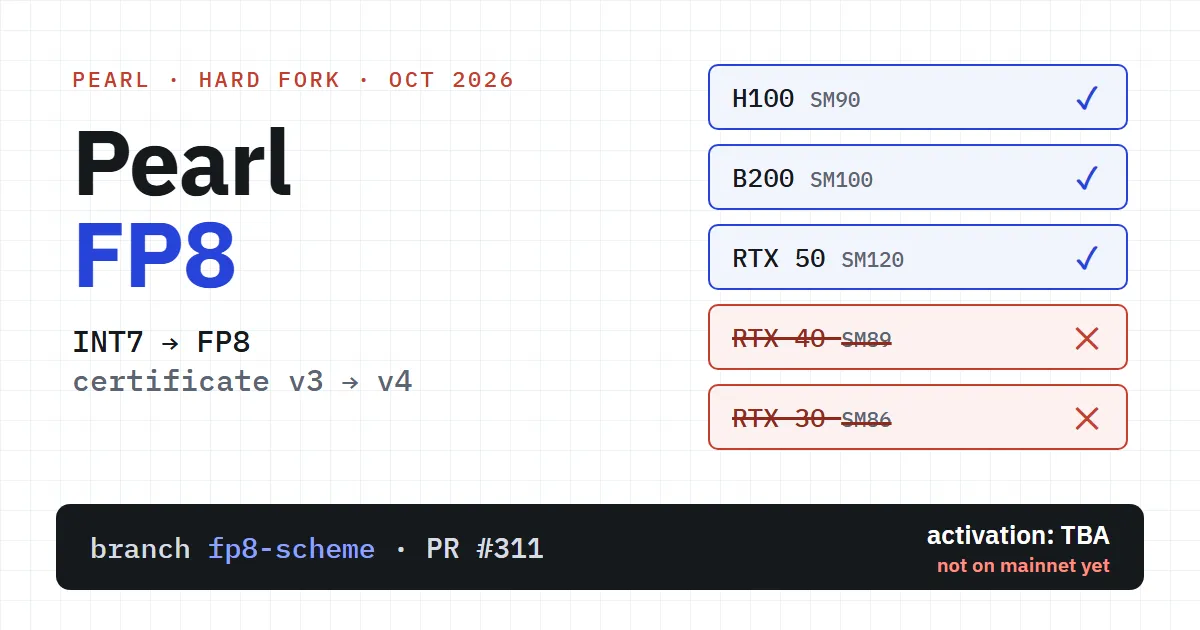
📌 Status as of October 3, 2026: the FP8 scheme (certificate v4) lives in the
fp8-schemebranch and has not been merged into the main branch. No activation block or date has been announced. The network runs on the current protocol from the August 11 hard fork, so your miner keeps earning as long as it is up to date.
What FP8 is and why Pearl wants it
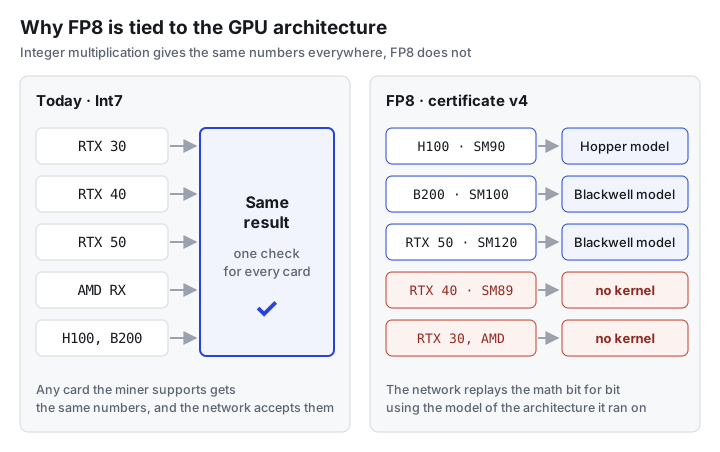
Pearl pays for matrix multiplication, the same math neural networks run on. Today the miner multiplies integer matrices (Pearl's code calls the format Int7). That makes verification easy: integer multiplication gives the same result on any GPU.
FP8 is an 8-bit floating-point format, and it is what large-model inference in data centers runs on today. Pearl's idea is simple: if mining uses the same format as real inference, a GPU can serve a model and mine at the same time. The branch tests already show this. A testnet block was mined by a "vLLM miner" on an NVIDIA B200 while it was running the Qwen3-4B model.
The catch is that FP8 math differs between architectures: rounding and accumulation order are not the same. The network has to reproduce the computation bit for bit, so the protocol describes specific architectures. The FP8 branch defines two: Hopper and Blackwell.
What the GitHub code confirms
Everything below comes from the public pearl-research-labs/pearl repository. Dates are UTC.
| Date | Change | What it means |
|---|---|---|
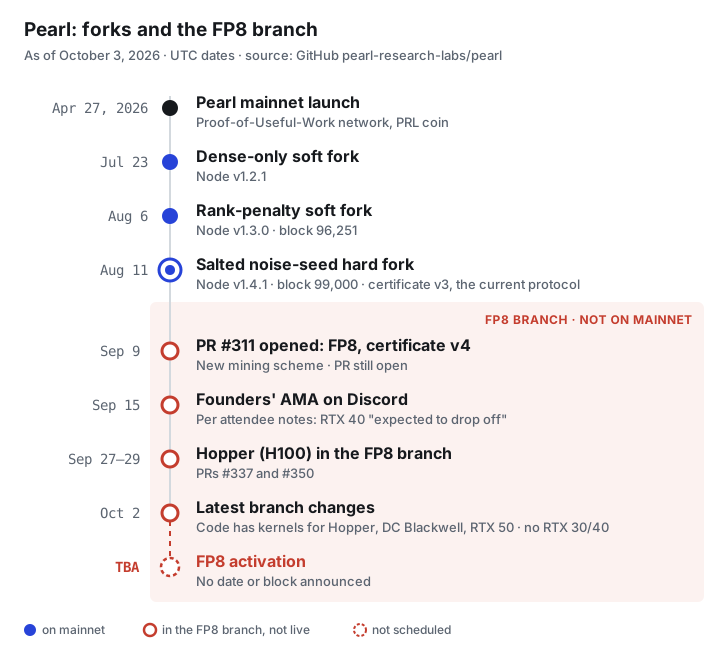
| Sep 9 | PR #311 "certificate-v4 + mining" opened | Start of the FP8 scheme. Still open |
| Sep 23 | PR #335: v4 certificate limits | Proofs capped at 60,000 bytes, same as current versions |
| Sep 27 | PR #337: Hopper (H100) support | Quantization and verification became device-specific |
| Sep 27 | PR #340: CPU miner and GPU emulation removed | Mining only on real GPU kernels |
| Sep 28 | PR #343: MoE support | Mining on Mixture-of-Experts models |
| Sep 29 | PR #350: Hopper in the miner | The branch miner runs on H100 |
| Oct 2 | PR #355 merged | v4 format changed, old test proofs no longer verify |
| Oct 2 | PRs #362 and #363 opened | Code split by version and precision fixes |
Which GPUs the branch miner knows. The FP8 kernel code (pearl-gemm) has three families:
- SM90: Hopper, i.e. H100 and H200;
- SM100: data-center Blackwell, i.e. B200 and related parts;
- SM120: workstation and consumer Blackwell, i.e. the RTX 50 series.
On any other architecture the miner exits with an unsupported-GPU error. That covers Ada (RTX 40), Ampere (RTX 30) and Turing (RTX 20). There are no AMD or Intel kernels in the branch at all, because the miner is built on CUDA.
One more takeaway: the scheme is not final. PR #355 states that the v4 format changes in place, with no activation gate, and that older test proofs are now rejected. That is how a team works on a protocol that is not live yet.
What is known only second-hand
The founders' AMA on September 15. It was held in the project's Discord, and Pearl has not published a recording. The account comes from notes posted on X by an attendee, which TechFinancials reviewed on October 1. According to those notes:
- FP8 support is written and on GitHub, but it needs a hard fork to activate;
- FP4 is next, targeted for the first quarter of 2027;
- older GPUs will struggle to stay on the network, and the founders expect the 40 series, RTX 4090 included, to drop off before long.
The SRBMiner developer. In the 3.6.8 release notes from September 19, the author wrote that Pearl will soon get an upgrade that leaves consumer GPUs close to useless. That release was tuned for maximum hashrate rather than efficiency for that reason.
⚠️ Important. There is no official hard fork announcement with a date and block, and the rules may still change. But the branch code matches what the founders said: RTX 40 is not in it.
Which cards are at risk: our assessment
This table is our assessment as of October 3, based on the branch code and hardware specs. The final list depends on what ships in the hard fork.
| Cards | FP8 in hardware | In the FP8 branch | Risk after the fork |
|---|---|---|---|
| GTX 16 series, RTX 20 series (Turing) | no | no | high |
| RTX 30 series (Ampere) | no | no | high |
| RTX 40 series (Ada) | yes | no | high, stated directly at the AMA |
| RTX 50 series (Blackwell) | yes, plus FP4 | yes, SM120 kernel | lowest among gaming cards, but nobody has published hashrates yet |
| H100, H200 (Hopper) | yes | yes, SM90 kernel | low |
| B200 (Blackwell) | yes | yes, SM100 kernel | low |
| AMD, Intel | depends on generation | no | high |
Why RTX 30 has no chance even in theory: Ampere tensor cores handle FP16, BF16, TF32 and INT8, but not FP8. Hardware FP8 arrived with Ada (RTX 40) and Hopper. RTX 40 has the hardware, but without its own kernel and a device model in the protocol it cannot produce a proof the network accepts.
💡 If the fork ships like this, Pearl becomes a coin for data centers and RTX 50 owners. For every other gaming rig it is the Ethereum 2022 scenario: the hardware stays, the coin leaves.
Fresh Pearl releases: September 25 to October 2
Until the fork lands, miner developers keep speeding up the current pearlhash algorithm. Latest versions as of October 3:
| Miner | Version and date | What's new |
|---|---|---|
| BzMiner | v100.45, Oct 2 | About +2% on Pearl for NVIDIA, faster Quantus on AMD and RTX 30/50, big Pearl gain on Intel Battlemage, pool reconnect fix |
| BzMiner | v100.41, Oct 1 | Pearl and Quantus on GTX 1660, faster Pearl on RTX 20, fixed NVIDIA overclocking on Windows |
| OneZeroMiner | v1.7.7, Oct 1 | Pearl on RTX 50, H100/H200/H800 and B200, gains on older generations, new --kernel option |
| SRBMiner-Multi | 3.7.1, Sep 29 | Faster Quantus on AMD and Intel |
| SRBMiner-Multi | 3.7.0, Sep 28 | Quantus on Intel Arc, small Pearl gain on NVIDIA, integrated GPUs off by default |
| WildRig Multi | 0.51.3, Sep 25 | Up to 10% better Pearl power efficiency on NVIDIA |
🛡️ Download miners only from these links, the developers' GitHub release pages. Windows Defender will delete the archive right after you unpack it, which is expected: add the folder to exclusions as shown in Windows Defender blocks miners.
OneZeroMiner's new --kernel option picks the pearlhash kernel: 1 or 2, comma-separated per card in order. The default is 1 and it is usually faster. The developer suggests trying 2 on Ampere and Ada cards. Pearl in OneZeroMiner is NVIDIA-only, with a 1% fee:
onezerominer.exe -a pearlhash -o POOL_HOST:PORT -w YOUR_ADDRESS --worker RIG_ID --kernel 2
For a three-card rig with mixed kernels: --kernel 1,2,2. Take the host and port from your pool's site; OneZeroMiner accepts an ssl:// prefix for encrypted connections. Compare kernels by accepted shares on the pool over 30–60 minutes, not by the number in the miner window.
In SRBMiner 3.7.0, integrated graphics are no longer picked up automatically. If you deliberately mined on an iGPU, add --enable-igpu to your .bat.
Node and wallet. Node v1.4.11 from September 29 is a maintenance release, not a fork: faster certificate reads, wallet fixes, and the old DNS seeds on the pearlresearch.ai domain removed. Desktop Wallet 2.0.7 from September 30 fixes sends that got stuck as "pending". If you run your own node or had stuck transfers, update.
What to do right now
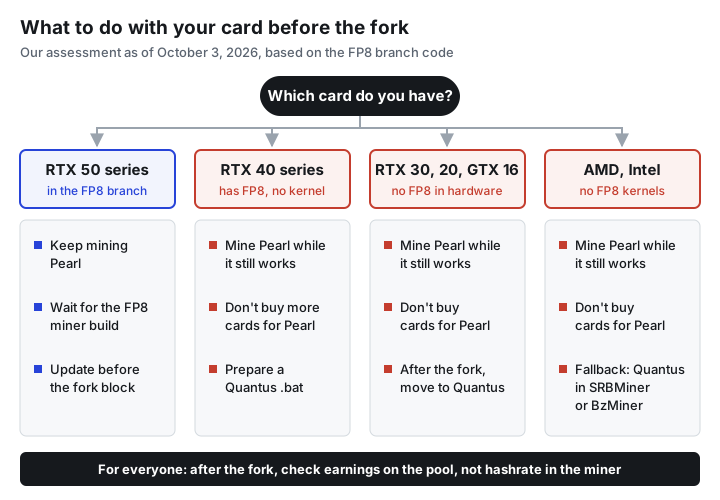
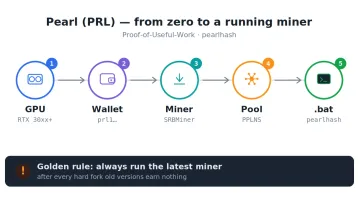
1. Keep mining, but on the latest version. The current protocol works and pays. Stay on Latest: two or three optimization releases land every week. For a safe SRBMiner download and hash check, see SRBMiner-Multi: setup and commands; for other miners, see our mining software overview.
2. Don't buy RTX 30 or 40 cards for Pearl. If your payback math for an RTX 3090 or 4090 runs six months out, Pearl may drop out of it. Over the last seven days of September, PRL fell 15.8% to $1.22 on September 30 (CoinGecko data).
3. Have a fallback coin ready. Quantus (QTC) runs on SRBMiner and BzMiner across NVIDIA, AMD and Intel, and both miners speed it up in almost every release. Step by step: how to mine Quantus on a GPU. Keep a second .bat ready so you can switch in a minute.
4. Watch for four signals. The fork won't arrive out of nowhere:
- PR #311 is merged into the
masterbranch of the Pearl repository; - a node release appears with "hardfork" and a block number in it, as with the August 11 fork;
- miner releases carry a "MANDATORY UPDATE" note with a block number;
- your pool posts a notice with a list of compatible versions.
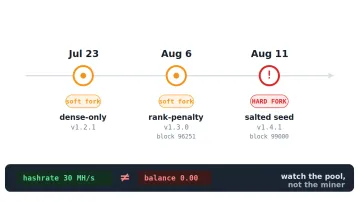
5. After the fork, check the pool, not the miner. An outdated miner after a Pearl hard fork keeps showing full hashrate while the network rejects its shares. The trap is covered in detail in our Pearl forks timeline. If rejected shares spike on the pool, see Rejected shares.
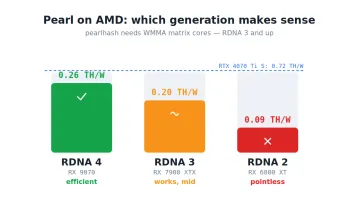
⚠️ Important. If you mine on AMD, the FP8 branch has no AMD kernels. The current picture for AMD cards is in mining Pearl on AMD GPUs, but plan for Pearl on AMD to end after the fork.
Frequently asked questions (FAQ)
When is the Pearl FP8 hard fork?
No date has been announced. As of October 3, PR #311 is open, not merged into the main branch, and no activation block is set. For past forks Pearl announced the block a few days ahead, so watch the node releases.
Will the RTX 4090 stop mining Pearl?
There are no official rules yet. But the FP8 branch miner only knows Hopper, data-center Blackwell and consumer Blackwell. Ada (RTX 40) is not among them, so on a 4090 it exits with an unsupported-architecture error. The founders said the same at the September 15 AMA.
What about the RTX 3090 and 3080?
Ampere has no hardware FP8, so these cards cannot run the v4 scheme unless the network keeps a separate path for them. Neither the code nor the AMA notes mention such a plan.
Will Pearl work on the RTX 5090?
Judging by the code, yes: the FP8 branch has a dedicated SM120 kernel for workstation and gaming Blackwell cards, which covers the whole RTX 50 lineup. But the final device list will only come with the fork, and nobody has published gaming-card hashrates yet.
Do I need to update my miner right now?
There is no mandatory update: FP8 miners for mainnet don't exist yet. Updating to Latest is still worth it for hashrate gains and fixes. For example, BzMiner v100.45 fixes pool reconnects.
What is certificate v4?
It is the version of the proof-of-work format a miner attaches to a block. The current network uses certificate v3, introduced by the August 11 hard fork. Certificate v4 is the FP8 scheme.
Sources
- Pearl repository on GitHub: PR #311 certificate-v4 + mining, PRs #335, #337, #340, #343, #350, #355, #362, #363, the
fp8-schemebranch code (miner/pearl-gemm) and node and wallet releases. - Miner releases: SRBMiner-Multi (3.6.8, 3.7.0, 3.7.1), BzMiner (v100.41, v100.45), OneZeroMiner (v1.7.7), WildRig Multi (0.51.3).
- AMA account from September 15 and PRL market data for September 30: TechFinancials, October 1, 2026.
This material is for informational purposes only and is not financial advice. Pearl is an experimental network: the fork's contents and the list of supported cards may change before activation.