Mining Pearl (PRL) on AMD: SRBMiner 3.6 and WildRig 0.50 — which cards make sense
Pearl on AMD: SRBMiner-Multi 3.6, WildRig 0.50 on RDNA 2/3/4. RX 6000/7000/9000 hashrates, income at $0.05 and $0.10/kWh, .bat files, MCT and why RDNA 2 lags.
All summer Pearl (PRL) was an NVIDIA coin: the pearlhash algorithm is matrix multiplication, which is exactly what RTX tensor cores are built for. By September 2026 both major miners have brought AMD support to a working state: SRBMiner-Multi 3.6.0 from August 27 extended it from RDNA 2 alone to the whole RDNA family, and WildRig Multi 0.50.2 and 0.50.3 from August 21–22 fixed the Radeon bugs. This guide covers what that means for RX 6000/7000/9000 owners in numbers, which cards are worth running and which are not, ready .bat files for both miners, and how to tune a card for pearlhash.
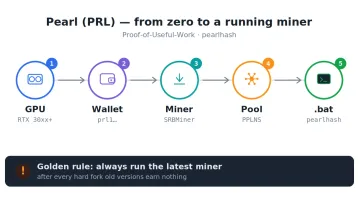
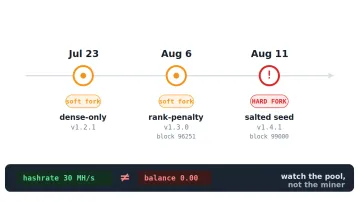
The basics — wallet, pools, what PoUW is — are in the main Pearl mining guide; the hardfork timeline and why the miner must be kept updated is in the Pearl forks article. This one is AMD only.
📌 Status as of September 7, 2026: the Pearl network is around 26–29 EH/s, and hashrate.no estimates revenue at roughly $0.013 per day per 1 TH/s at a PRL price near $0.36. The numbers move daily; recalculate before starting.
The short version: AMD works, but not all of it
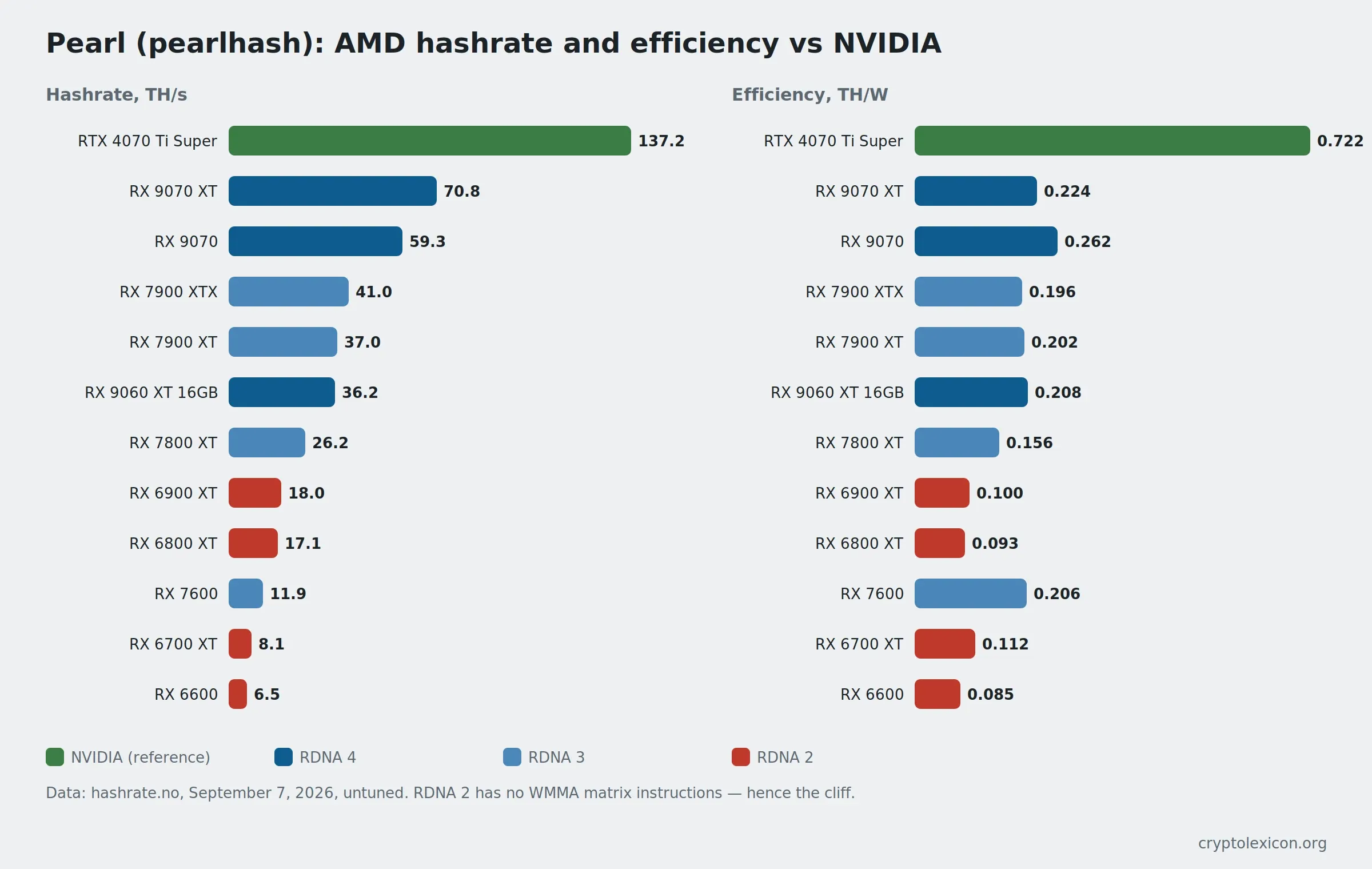
Pearlhash computes low-precision matrices. NVIDIA has tensor cores for that; AMD has WMMA matrix instructions, which arrived only in RDNA 3 and were sped up noticeably in RDNA 4. RDNA 2 has none, and the hashrate.no benchmarks (September 7, 2026) show it:
| Card | Generation | Hashrate | Efficiency | Power (calculated) |
|---|---|---|---|---|
| RX 9070 XT | RDNA 4 | 70.8 TH/s | 0.224 TH/W | ~316 W |
| RX 9070 | RDNA 4 | 59.3 TH/s | 0.262 TH/W | ~226 W |
| RX 9060 XT 16 GB | RDNA 4 | 36.2 TH/s | 0.208 TH/W | ~174 W |
| RX 7900 XTX | RDNA 3 | 41.0 TH/s | 0.196 TH/W | ~209 W |
| RX 7900 XT | RDNA 3 | 37.0 TH/s | 0.202 TH/W | ~183 W |
| RX 7900 GRE | RDNA 3 | 35.8 TH/s | 0.176 TH/W | ~203 W |
| RX 7800 XT | RDNA 3 | 26.2 TH/s | 0.156 TH/W | ~168 W |
| RX 7700 XT | RDNA 3 | 23.7 TH/s | 0.149 TH/W | ~159 W |
| RX 7600 | RDNA 3 | 11.9 TH/s | 0.206 TH/W | ~58 W |
| RX 6900 XT | RDNA 2 | 18.0 TH/s | 0.100 TH/W | ~180 W |
| RX 6800 XT | RDNA 2 | 17.1 TH/s | 0.093 TH/W | ~184 W |
| RX 6700 XT | RDNA 2 | 8.1 TH/s | 0.112 TH/W | ~72 W |
| RX 6600 | RDNA 2 | 6.5 TH/s | 0.085 TH/W | ~76 W |
| For reference: RTX 4070 Ti Super | Ada | 137.2 TH/s | 0.722 TH/W | ~190 W |
What follows from this:
- RDNA 4 (RX 9000) is the only AMD generation where pearlhash reaches sensible efficiency: the RX 9070 holds 0.26 TH/W, the level of an RTX 2060 Super and half of an RTX 3070.
- RDNA 3 (RX 7000) works, but at 0.15–0.20 TH/W. An RX 7900 XTX matches an RTX 3060 in hashrate.
- RDNA 2 (RX 6000) sits at 0.08–0.11 TH/W. An RX 6800 XT produces less than an RTX 3050. Mining Pearl on these cards only makes sense with free electricity.
- Polaris, Vega, RDNA 1 are not supported by any miner.
⚠️ Important. Someone in a chat will insist that "Pearl flies on a 6800 XT". It does not: 17 TH/s at 184 W is 8 times worse efficiency than an RTX 4070 Ti Super. If you have RX 6000, go by the table below, not by hearsay.
Economics: what is left after electricity
Revenue at the hashrate.no rate ($0.0131 per TH/s per day, September 7, 2026) minus electricity at the calculated power from the table above. PRL price and difficulty change, so this is an order of magnitude, not a forecast.
| Card | Gross per day | Net at $0.05/kWh | Net at $0.10/kWh |
|---|---|---|---|
| RX 9070 XT | $0.93 | $0.55 | $0.17 |
| RX 9070 | $0.78 | $0.51 | $0.23 |
| RX 9060 XT 16 GB | $0.47 | $0.27 | $0.06 |
| RX 7900 XTX | $0.54 | $0.29 | $0.04 |
| RX 7900 XT | $0.48 | $0.27 | $0.05 |
| RX 7800 XT | $0.34 | $0.14 | −$0.06 |
| RX 7600 | $0.16 | $0.09 | $0.02 |
| RX 6800 XT | $0.22 | $0.00 | −$0.22 |
| RX 6600 | $0.09 | −$0.01 | −$0.10 |
| RTX 4070 Ti Super | $1.80 | $1.57 | $1.34 |
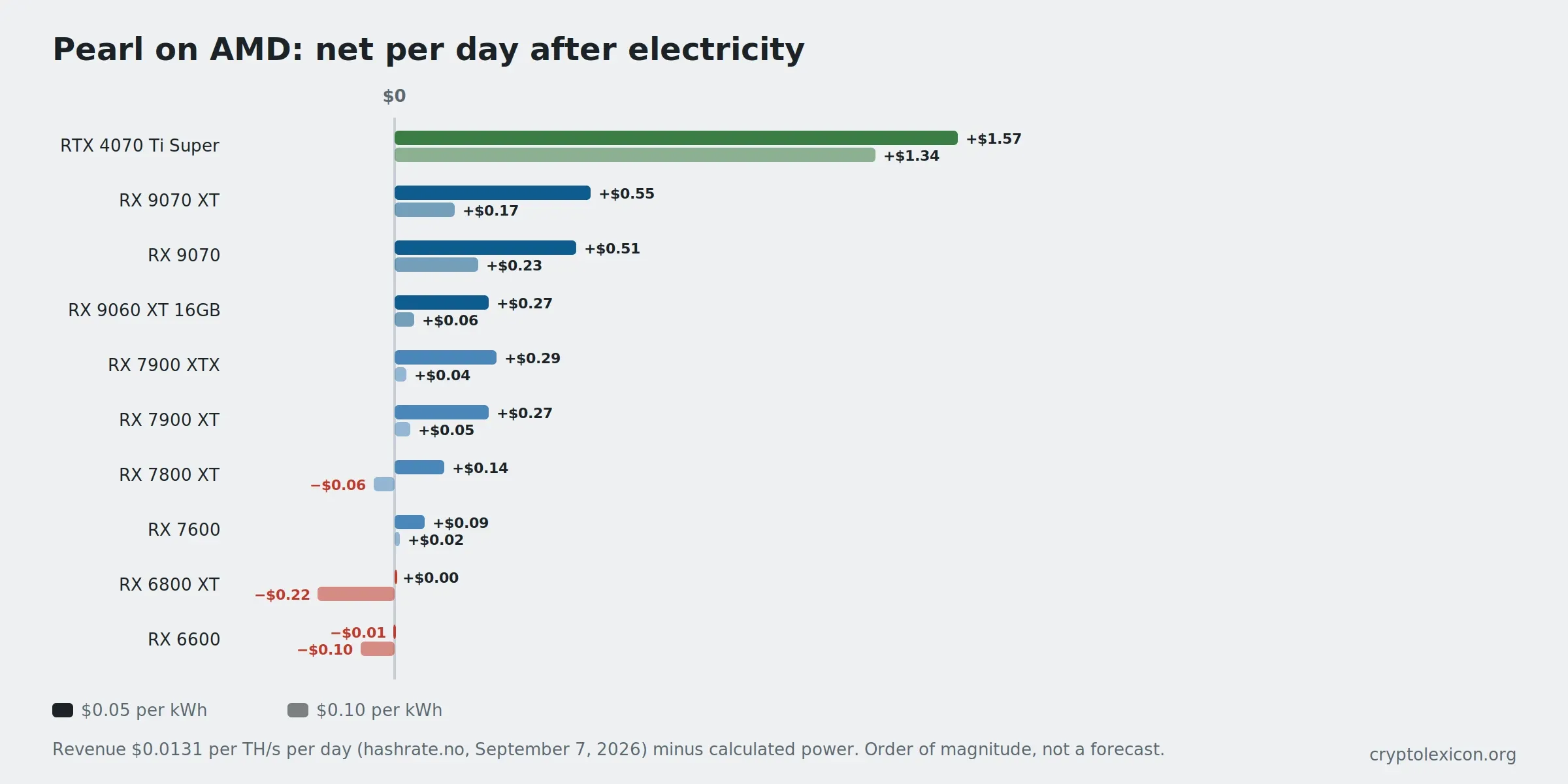
The conclusion is simple: at $0.10/kWh only RDNA 4 and the top RDNA 3 cards stay positive on AMD, and that positive is cents. At $0.05 the picture is tolerable for RX 7900/9070, while RX 6000 lands at zero or below in every scenario. If electricity costs more than $0.10, Pearl is not mined on AMD.
💡 The hashrates in the table are "as is" from the hashrate.no database, without fine tuning. Undervolting through MCT (below) cuts power by 15–25 % and moves net income up; hashrate barely drops because pearlhash is bound by the matrix units, not core clock.
What you need
- SRBMiner-Multi 3.6.x or WildRig Multi 0.50.x — only from the authors' GitHub (repositories
doktor83/SRBMiner-Multiandandru-kun/wildrig-multi). Check the MD5 from the release: pearlhash has already had two emergency hardforks, and old builds simply stop getting shares accepted. - A recent Adrenalin driver. On old drivers the WMMA path may not come up, and the card either is not detected or shows RDNA 2-level hashrate.
- A PRL wallet — from the main guide.
- A pool: Kryptex (1 % fee, has a Russian server), pearlhash.xyz (1 % pool fee, 0 % devfee with WildRig) or K1Pool (since June 27 pays a second coin, MDL, for the same hashrate).
| Miner | Version on September 7, 2026 | AMD | Devfee on pearlhash |
|---|---|---|---|
| SRBMiner-Multi | 3.6.1 (August 30) | RDNA 2 since 3.3.5, the whole RDNA family since 3.6.0 | 2 % |
| WildRig Multi | 0.50.9.1 (September 1) | Fixed in 0.50.2–0.50.3 | 0 % on pearlhash.xyz, otherwise the miner default |
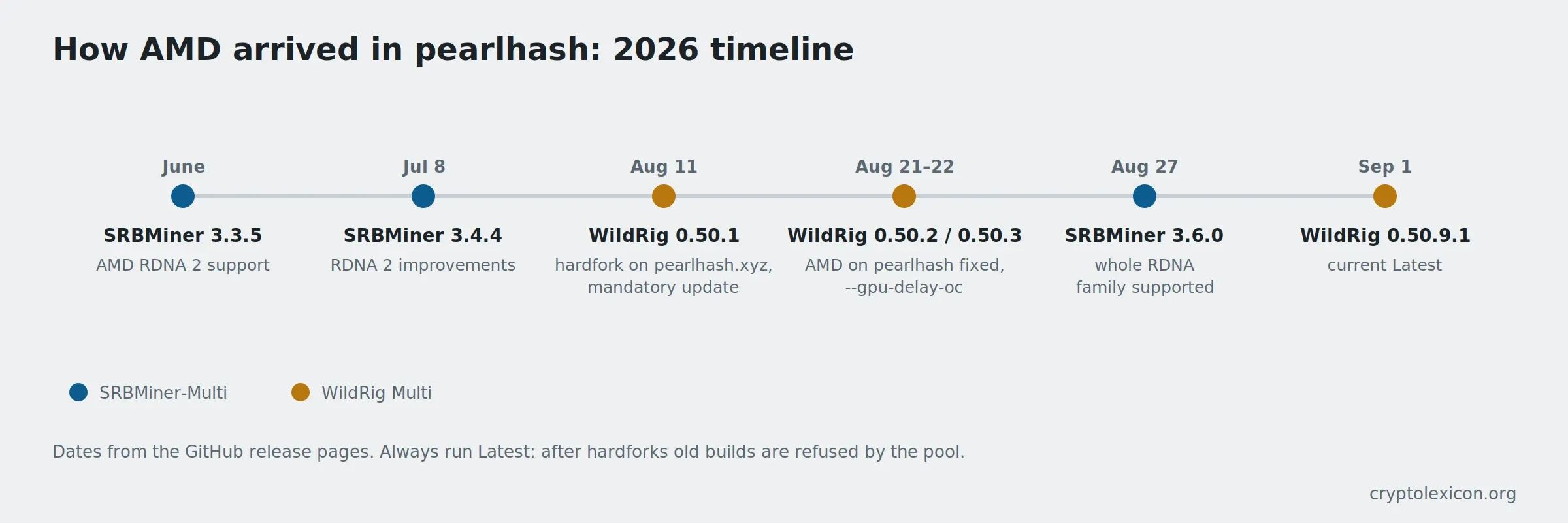
Always take Latest: SRBMiner shipped nine releases in August, WildRig eleven.
🛡️ Windows Defender removes both miners as "potentially unwanted". Put the folder in exclusions before extracting: how to do it.
Step 1. SRBMiner-Multi: .bat for AMD
The command is the same as for NVIDIA; the miner picks the code path for the generation itself. Kryptex pool, global server:
@echo off
cd /d %~dp0
SRBMiner-MULTI.exe --disable-cpu --algorithm pearlhash --pool prl.kryptex.network:7048 --wallet YOUR_ADDRESS.RIG_ID
pause
Regional servers such as prl-eu.kryptex.network:7048 exist, and SSL is port 8048 on the same host. The full server list is on the pool page.
If the rig mixes AMD and NVIDIA, SRBMiner starts all of them; the --pearl-k2 switch (alternative kernel) only applies to NVIDIA, leave it alone on Radeon. The remaining switches and syntax are in SRBMiner-Multi: setup and commands.
Step 2. WildRig Multi: .bat for AMD
WildRig has been developed for Pearl together with the pearlhash.xyz pool team since 0.48.0, and on that pool it charges 0 % devfee. The pool endpoint is global, one for all regions:
@echo off
cd /d %~dp0
wildrig.exe --algo pearlhash --url stratum+tcp://pool.pearlhash.xyz:9000 --user YOUR_ADDRESS.RIG_ID
pause
On another pool substitute its address; the devfee is then WildRig's standard one. If the miner applies overclocking before the driver is ready and the card drops out, add --gpu-delay-oc (introduced in 0.50.3).
💡 pearlhash.xyz runs its own Pearl hardfork, supported in WildRig since 0.50.1. Make sure the miner build is not older than August 11, or shares will be rejected.
Step 3. Tuning the card for pearlhash
Pearlhash loads the matrix units, not memory: VRAM overclocking gives almost nothing, while lowering core voltage gives a lot. On RX 6000/7000/9000 this is done without flashing, through MoreClockTool:
- Record the baseline: hashrate from the miner, watts from HWiNFO, 15 minutes.
- Lower Voltage in 25 mV steps; leave Frequency Max alone for now — pearlhash on AMD is sensitive to matrix-unit clock.
- Once voltage hits its stable floor, try dropping Frequency Max by 100–150 MHz and see how much hashrate goes. More than 5 % — put it back.
- Memory Fast Timing Level and memory clock — leave at stock, there is no gain here.
- Fans — fixed 60–70 %: matrix load heats the chip more evenly than Ethash-style algorithms, and the hotspot climbs faster.
Starting points (every chip differs; this is only where to begin):
| Card | Voltage | Frequency Max | Expected effect |
|---|---|---|---|
| RX 9070 XT | 900–950 mV | 2600–2700 MHz | −60…−80 W at −3…−5 % hashrate |
| RX 9070 | 875–925 mV | 2400–2500 MHz | −40…−50 W |
| RX 7900 XTX | 900–950 mV | 2200–2400 MHz | −40…−60 W |
| RX 7800 XT | 875–925 mV | 2100–2300 MHz | −30…−40 W |
What rising rejects after undervolting mean and how to tell a card problem from a pool problem is in rejected shares.
Errors and fixes
The miner does not see the AMD card / hashrate 0. Old driver or a miner version predating RDNA support: SRBMiner had no RDNA 2 before 3.3.5 and no other RDNA before 3.6.0; WildRig had no working AMD on pearlhash before 0.50.2. Update both.
proof validation failed or mass rejects. Almost always an outdated build after a hardfork. SRBMiner 3.5.3 and WildRig 0.50.1 were mandatory updates; anything older is refused by the pool.
RX 7900 XTX hashrate like an RX 6800. The WMMA path did not start: update Adrenalin, remove all third-party overclocking, reboot and run the miner at stock.
The card drops out after a few minutes. Undervolt too aggressive: pearlhash gives a steady load, and the stability threshold is lower than on KawPow. Add back 25 mV.
The miner closes right after launch. General causes are in miner won't start: 8 causes; for AMD it is most often a missing recent driver or a card absent from Device Manager.
Frequently asked questions (FAQ)
Is Pearl worth mining on an RX 6600 / 6700 XT?
With paid electricity — no: 6.5–8 TH/s yield $0.09–0.11 per day gross, before watts. With free electricity — possible, but those cards are used more efficiently on KawPow or Autolykos.
Which AMD card is best for Pearl?
By efficiency — the RX 9070 (0.26 TH/W); by absolute hashrate — the RX 9070 XT (71 TH/s). Both still trail an RTX 4070 Ti Super by 2–3× at the same power.
SRBMiner or WildRig on AMD?
The hashrate difference is within a few percent and shifts from release to release. The practical difference is the fee: WildRig on pearlhash.xyz takes 0 %, SRBMiner 2 %. Run both for 30 minutes and keep the one that is more stable on your driver.
Does it work on HiveOS?
Both miners have Linux builds and custom packages for HiveOS, but AMD pearlhash status on Linux is not described separately in the releases. Test on one card before moving the rig.
What about MDL on K1Pool?
Since June 27 K1Pool pays a second coin, MDL, to everyone mining Pearl on the pool with no loss of PRL hashrate. It is a bonus, not a reason to pick the pool: MDL has no meaningful liquidity yet.
Will AMD keep trailing for long?
The gap is hardware: tensor cores versus WMMA. Miner optimizations close it by percentages, not multiples. If buying a card specifically for Pearl — NVIDIA only.
Conclusion
AMD support in pearlhash is real and recent, but it makes Pearl a "mine on what you have" option, not a "buy for Pearl" one. RX 9070/9070 XT and the top RX 7900 cards net a few tens of cents a day on cheap electricity, RX 7800 and below hover around zero, RX 6000 is negative everywhere except a free outlet. Update the miner after every hardfork, undervolt through MCT, and recalculate weekly: Pearl's difficulty is growing faster than any other GPU coin's this year.
This material is for informational purposes only and is not financial advice. Hashrates and revenue are from hashrate.no as of September 7, 2026 and change daily; check miner versions on the authors' GitHub.