Difficulty up 1.31%, hashprice up 22%: what actually changed for miners
On Sept 6, 2026 Bitcoin difficulty hit 127.45T, hashprice rose from $32.42 to $39.63 per PH/s/day, hashrate stayed at 934 EH/s. Why, and how to recheck profit.
On September 6 the Bitcoin network recalculated difficulty: at block 965,664 it rose 1.31% to 127.45 trillion. Over the same period hashprice — revenue per unit of hashing power — gained 22.24%, while total network hashrate barely moved. That combination is uncommon and has concrete consequences for your wallet. Here is what changed, why difficulty rose while hashrate stood still, and how to recalculate your own numbers in five minutes.
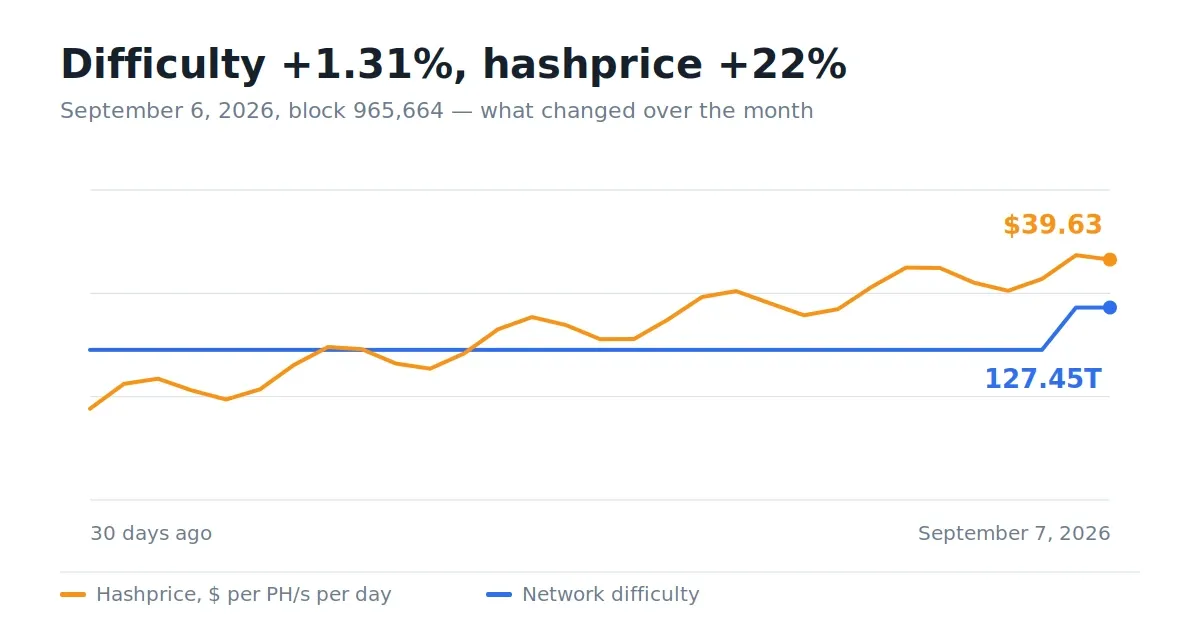
📌 Status as of September 7, 2026: difficulty 127.45T, hashrate around 934 EH/s (still under 1 ZH/s), hashprice roughly $39.63 per PH/s per day, fees at 0.43% of total miner rewards over the past 24 hours, BTC around $79,700. These figures move daily — verify against mempool.space and hashrateindex.com.
What happened on September 6
The retarget itself was routine. The numbers around it are the interesting part.
| Metric | Value | Change |
|---|---|---|
| Retarget block | 965,664 | — |
| Difficulty | 127.45T | +1.31% |
| Network hashrate | ~934 EH/s | essentially flat |
| Hashprice | ~$39.63 per PH/s/day | +22.24% over 30 days |
| Fee share of rewards | 0.43% | consistently low |
| Increase number in 2026 | 8th | out of 18 retargets this year |
Rows two and three are the story. Difficulty went up; hashrate did not. That looks like a contradiction. It is not.
Why difficulty rose while hashrate stayed flat
The network does not measure hashrate. There is no power meter in the protocol, and Bitcoin has no way to know how much hardware is running right now. It measures the one thing available to it: time.
The mechanism:
- Every 2,016 blocks a node takes the timestamps of the first and last block of the epoch and computes how long the epoch actually took.
- The target is 20,160 minutes — 2,016 blocks at 10 minutes each, exactly two weeks.
- New difficulty = old difficulty × (target time ÷ actual time).
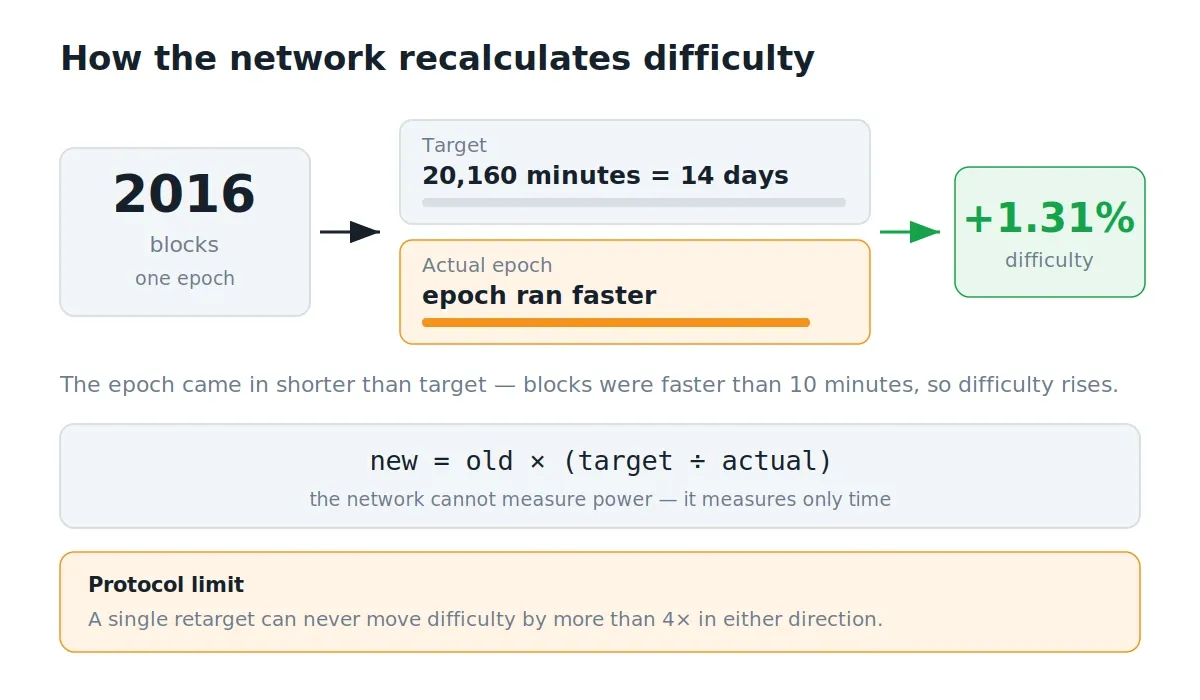
Faster than two weeks, difficulty rises. Slower, it falls. The change is clamped to a factor between 0.25 and 4, so a single retarget can never move difficulty by more than 4× in either direction.
That answers the question. The past epoch was mined slightly faster than the two-week target, which was enough for +1.31%. But an epoch spans roughly fourteen days, while the "current hashrate" you see on trackers is an estimate over the last 24 hours or a rolling seven days. Different observation windows. Difficulty responds to a two-week average, not to today.
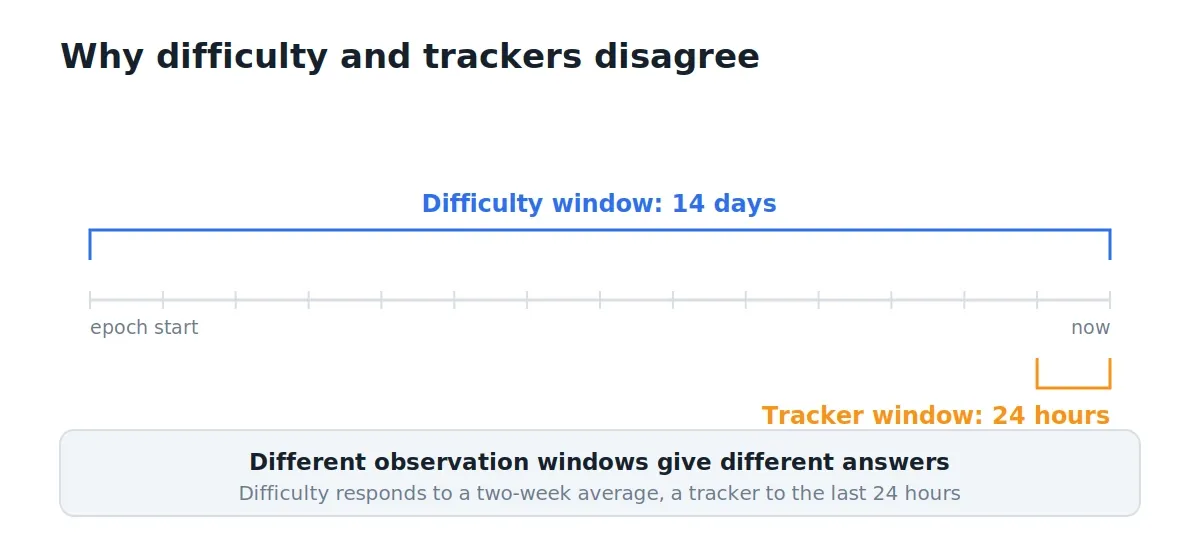
💡 Practical takeaway: difficulty is always a look backwards. It tells you what hashrate was two weeks ago, not what it will be tomorrow. Planning profitability around a fresh retarget is driving by the rear-view mirror.
One more detail rarely mentioned: Bitcoin's implementation contains a well-known off-by-one — the interval is measured across 2,015 blocks rather than 2,016. The error is tiny and has been in the protocol since the beginning; nobody is going to break compatibility over it.
Hashprice +22%: where the gain came from
Hashprice estimates how many dollars one petahash per second earns in a day. It is a useful metric because it folds three things into a single number: coin price, current difficulty, and fees in blocks.
Over thirty days hashprice went from roughly $32.42 to $39.63 per PH/s per day. Almost all of that is price. Bitcoin gained substantially over the month while difficulty moved very little. When price outruns difficulty, revenue per unit of hashing power rises — which is exactly what happened.
Fees at 0.43% — what that means in practice
Over the past day, fees made up 0.43% of total miner rewards. The other 99.57% is issuance: 3.125 BTC per block.
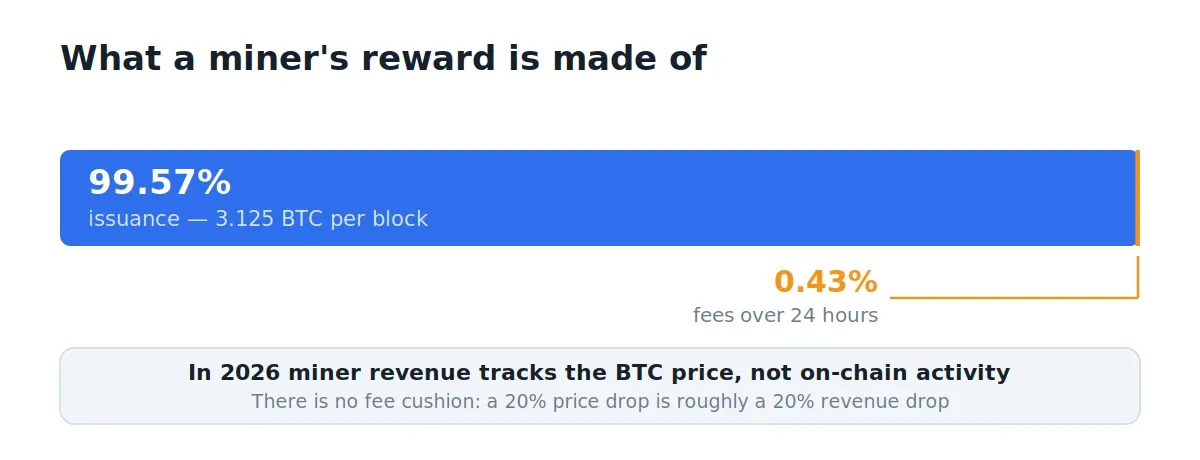
This matters more than it sounds. In 2026 miner revenue is almost entirely tied to the BTC exchange rate rather than to on-chain activity. Two consequences follow:
- Your revenue volatility equals price volatility. There is no fee cushion. A 20% price drop is roughly a 20% revenue drop until the next retarget.
- Planning around a fee spike does not work. Fee spikes in 2023–2024 delivered double-digit percentages of block rewards. That is not the current regime.
⚠️ Important. At a 0.43% fee share, choosing a pool based on "who captures fees better" is close to meaningless — the spread between the best and worst pool here is measured in hundredths of a percent. Look at payout scheme, pool fee, and stability instead. Details in how to choose a mining pool.
The 2026 arithmetic: why percentages do not add up
Since January 2026 the network has seen 18 retargets: eight increases and ten decreases. The eight increases sum to +33.34%; the ten decreases sum to −45.27%. Simple addition gives −11.93%.
In reality, difficulty fell from about 146.47T to 127.45T over the year — roughly 13%.
The gap is not an error. It is how percentages behave: they compound rather than add. A 10% drop followed by a 10% gain does not return you to the start: 100 → 90 → 99. So the arithmetic sum of changes (−11.93%) and the actual change (−13%) do not match, and should not.
The correct calculation:
result = (1 + a₁) × (1 + a₂) × ... × (1 + aₙ)
where each aᵢ is one retarget's change as a decimal (for example, +1.31% = 0.0131).
💡 Apply the same rule to your own projections. If you are modelling revenue several epochs out, you cannot add your difficulty forecasts — only multiply them.
How to recalculate your own numbers
For SHA-256 hardware this takes a couple of minutes and needs no calculator on a questionable website.
Step 1. Get the hashprice. Current value at hashrateindex.com. On September 7 it is roughly $39.63 per PH/s per day.
Step 2. Convert your hashrate to petahashes. 1 PH/s = 1,000 TH/s. A 200 TH/s machine is 0.2 PH/s.
Step 3. Multiply. 0.2 × 39.63 ≈ $7.93 gross per day.
Step 4. Subtract electricity. Kilowatts × 24 hours × your rate. A 3.5 kW machine at $0.06/kWh: 3.5 × 24 × 0.06 = $5.04 per day.
Step 5. The difference is your real revenue. In this example: 7.93 − 5.04 = $2.89 per machine per day, before pool fees and depreciation.
The full formula:
revenue = (TH/s ÷ 1000) × hashprice − (kW × 24 × rate)
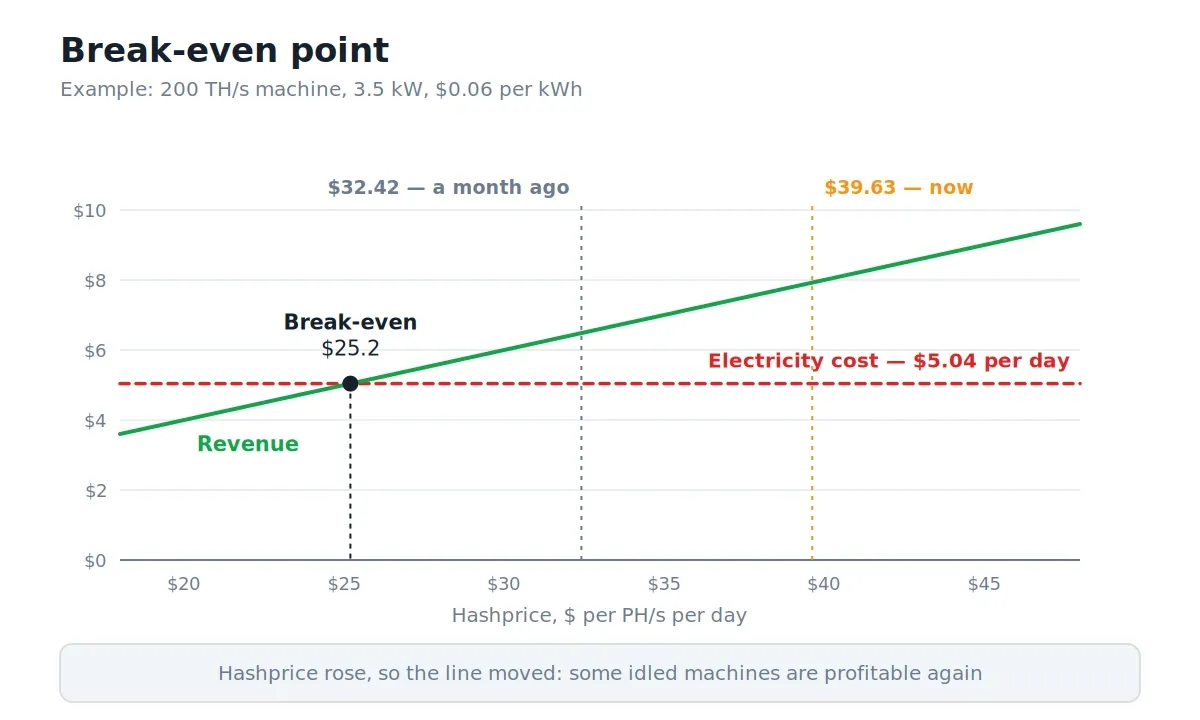
Break-even is easiest computed in reverse: divide your daily electricity cost by your hashrate in PH/s, and you get the hashprice below which the machine runs at a loss.
You can check current difficulty and the estimate for the next retarget straight from PowerShell using a public API:
Invoke-RestMethod "https://mempool.space/api/v1/difficulty-adjustment" | Format-List
The response includes the estimated next change in percent, blocks remaining, and current average block time. The endpoint is public and needs no key, though the response shape may change over time — if the fields look different, check the mempool.space documentation.
What this means for GPU miners
A Bitcoin retarget has no direct effect on graphics cards — BTC and GPU algorithms live on different networks with separate difficulties. But two indirect effects are real.
The used hardware market. A 22% hashprice gain makes older SHA-256 machines viable again in regions with cheap power. Some units that sat switched off are coming back online. For a GPU miner that means used ASIC prices are more likely to rise than fall over the coming weeks — if you were planning a purchase, the window of cheap listings is narrowing.
Attention flowing to altcoins. When Bitcoin profitability rises, some speculative interest leaves smaller coins for BTC, and some flows into forks and new chains on general optimism. This reaches your card's revenue only through the price of whatever coin you mine.
If you mine on GPUs and want to understand your own economics, two numbers matter more than Bitcoin difficulty: your rejected share percentage and your actual draw at the wall. The first is covered in rejected shares, the second in our guide to overclocking with MSI Afterburner.
What to do right now
A short list if you run SHA-256 hardware:
- Recalculate break-even using the formula above. Hashprice rose, so the line moved — some machines you switched off a month ago may be profitable again.
- Do not rush to switch everything back on. The hashprice gain came from price, and price can retrace. Work out at what BTC level your machine goes negative again and keep that number in mind.
- Check the next retarget. It is due in roughly two weeks. If hashrate stays flat, the change will be small.
- Do not switch pools over a retarget. Difficulty is identical across every pool — it is a network parameter, not a pool setting. Switching changes nothing here.
⚠️ Important. Any profitability calculator promising a fixed "monthly income" without stating current hashprice and your electricity rate is showing you fiction. Miner revenue is a number that gets recomputed every single day.
Frequently asked questions (FAQ)
Difficulty went up — am I earning less?
All else equal, yes, but only by 1.31%, and that is more than offset by the 22% hashprice gain. Net over the month you are earning noticeably more than in early August, higher difficulty included.
Why is hashrate not growing if mining got more profitable?
The leading explanation is physical constraints: sites with energised power capacity are scarce, and the ones that exist increasingly go to AI data centres. Bringing new hardware online takes months, not days, so hashrate responds to profitability with a long lag.
When is the next retarget?
Roughly two weeks out, but there is no fixed date: retargets are tied to block height, not the calendar. The next one lands on a block that is a multiple of 2,016. mempool.space shows a live estimate.
What is 1 ZH/s and why is everyone talking about it?
A zettahash is 1,000 EH/s, a round psychological threshold. The network has approached it on daily readings, but the smoothed seven-day average remains below — around 934 EH/s. That gap between daily peak and rolling average is why coverage contradicts itself: some outlets declare a record, others report stagnation, and both are technically correct.
Does Bitcoin difficulty affect altcoin mining?
Not directly. Every coin has its own difficulty and algorithm. Indirectly, yes — through hardware prices and through speculative capital moving between chains.
How quickly should I react to a difficulty change?
You should not. Retargets happen every two weeks and apply equally to every participant. The only sensible response is to recalculate break-even and decide whether to keep your machines running.
This material is for informational purposes only and is not financial advice. Difficulty, hashrate and hashprice figures are current as of September 7, 2026 per mempool.space and hashrateindex.com and change daily.