Hyperscale Data switches off every ASIC and pivots to AI: what it means for miners
On Sept 1, 2026 Hyperscale Data (GPUS) shut off its Michigan ASICs to free 20 MW for AI. Why it's a trend and how it hits difficulty, hashprice and used ASICs.
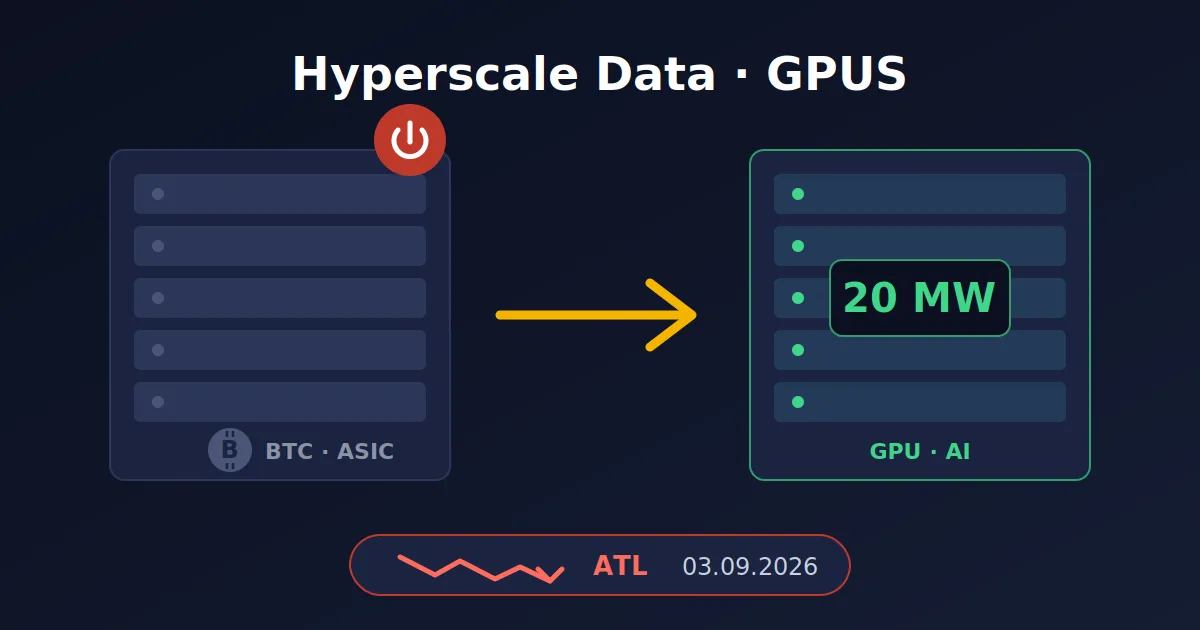
Public miner Hyperscale Data (NYSE American: GPUS) stopped all bitcoin mining at its Michigan data center on September 1, 2026, and on September 3 its shares set an all-time low. The site is being converted to 20 MW of AI infrastructure under a long-term contract. This note gives you the facts without speculation, the industry context (hashrate, difficulty, capex) and practical takeaways for home and small-farm miners.
📌 Status as of September 3, 2026: Hyperscale Data's miners have been off since September 1, GPUS is at a record low, network difficulty is around 125.81 T, and the next retarget is expected around September 5 with an estimated change of about −0.9 %. Check live network figures on the day you read this.
What happened
According to the company's press release, Hyperscale Data switched off every bitcoin miner at its Michigan facility effective September 1, 2026. The site is being prepared for AI capacity under a previously announced master services agreement with a California-based neocloud provider.
Known deal parameters from the release:
| Parameter | Value |
|---|---|
| AI capacity | 20 MW |
| Initial term | 10 years |
| Extension options | 2 × 5 years |
| Maximum term | 20 years |
| Expected revenue over 20 years | more than $1.2 billion |
| Mining shutdown date | September 1, 2026 |
The shutdown followed a facility inspection by the client. In other words, this was planned: the contract was signed first, the inspection came next, and only then were the ASICs powered down.
The market reacted badly: on September 3 GPUS shares fell to an all-time low. Investors are being asked to look 10–20 years ahead while mining revenue disappears today.
⚠️ Important. This is one site of one small public company. On its own it does not "crash" the bitcoin network. Its significance is the trend it confirms.
Why this is not a one-off
Hyperscale Data is the latest, not the first, miner to trade ASICs for GPU servers. Industry figures for the first half of 2026:
- Listed bitcoin miners and their AI data-center peers spent roughly $30.7 billion in capex in H1 2026 — more than all of 2025 (about $21.5 billion), an increase of around 42 %.
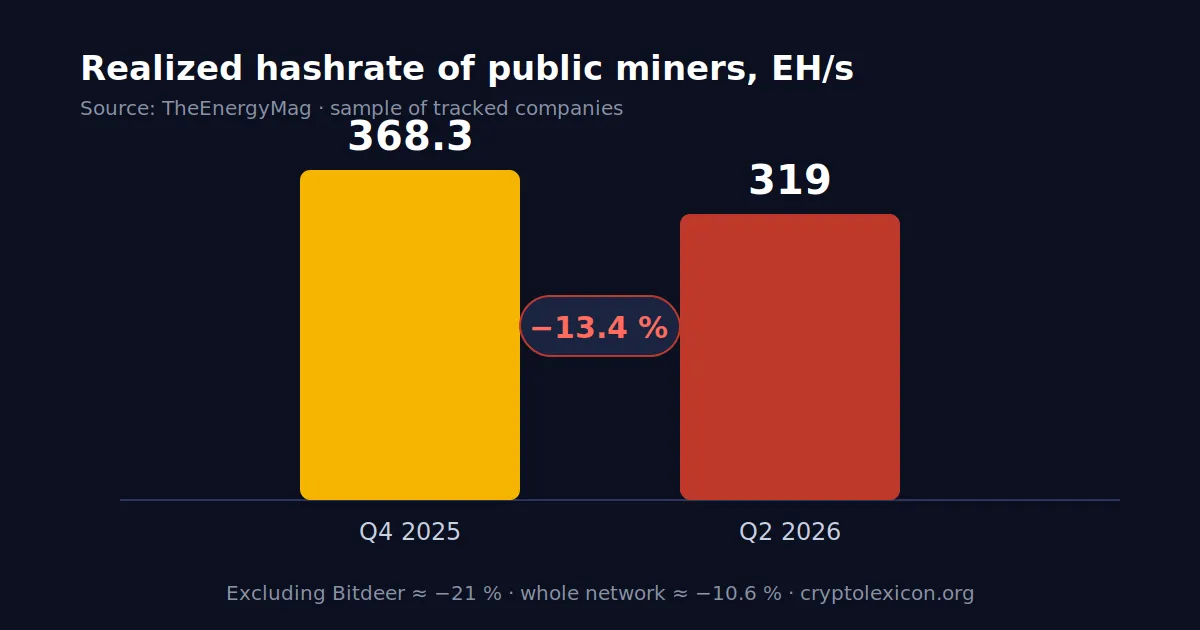
- Realized hashrate of the public miners tracked by TheEnergyMag fell about 13.4 % over six months: from 368.3 EH/s in Q4 2025 to 319 EH/s in Q2 2026.
- Excluding Bitdeer, which kept expanding against the trend, the decline for the rest was about 21 %.
- The network-wide quarterly average hashrate dropped roughly 10.6 % over the same period.
Other examples of the same move: Cango shut down about a third of its fleet to expand into AI, TeraWulf lined up $3.5 billion for an AI data center, and operators such as Hut 8, Core Scientific and IREN have been converting sites to GPU workloads for a while.
The logic is simple: a megawatt sold to AI compute under a multi-year contract yields predictable revenue for years. The same megawatt on ASICs depends on the BTC price, hashprice and the next halving in 2028.
What it does to the bitcoin network
Hashrate and difficulty
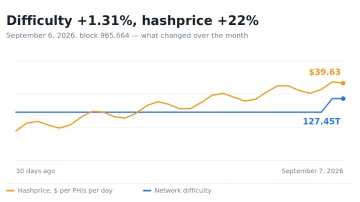
In 2026 difficulty has fallen more often than it has risen: as of late August, ten decreases versus seven increases. The current value is about 125.81 T, only 0.7 % above the year's low. Estimates put the amount of "switched-off" hashrate at around 150 EH/s.
The next retarget, per CoinWarz, is expected around September 5, 2026 with a change of about −0.94 % (based on average block time at publication).
💡 Every difficulty drop is a boost for those who stay online. That is why large operators call 2026 a "hashrate bear market": whoever does not power down gets a bigger share of blocks.
Hashprice
Hashprice (expected daily revenue per 1 PH/s) hovered around $28–32 through summer 2026 — one of the lowest dollar levels in the network's history, even with BTC trading near $78–79k in early September. For fleets on S19-class hardware (roughly 30 J/TH and worse) that is break-even territory even on cheap power.
New hardware
The exit of old machines coincides with a generation change in ASICs. Industrial purchases in 2026 are machines at roughly 9.5–11 J/TH (Antminer S23, SEALMINER A4 Pro, WhatsMiner M7x series). Companies staying in mining are refreshing fleets with these and moving to hydro and immersion cooling, which delivers 2–3× the density per megawatt.
What it means for a home miner
If you mine bitcoin on ASICs
- Run your numbers on current difficulty, not last year's. A few percent per quarter changes payouts noticeably. Recalculate ROI monthly.
- Watch the used-ASIC market. When sites like the Michigan one go dark, some machines end up on the secondary market. Old S19-series units get cheapest fastest but also pay back worst — at a hashprice near $30 they only work on power around $0.04–0.05/kWh or lower.
- Do not buy hardware on headlines. One story about falling hashrate does not cancel the 2028 halving, which cuts the block reward to 1.5625 BTC.
If you mine on GPUs
No direct impact: GPU mining stopped touching bitcoin long ago. Indirect effects exist:
- Large operators are reclaiming sites and power they used to rent out for hosting. Hosting rates for GPU rigs at such facilities are not going down.
- Data-center demand for server GPUs props up graphics-card prices — do not expect a flood of cheap cards from miners leaving for AI; if anything, the opposite.
💡 For a GPU miner the coin and pool choice matters more than ASIC news right now. How to compare pools by fee, minimum payout and latency: how to choose a mining pool. If your rejected-share rate climbs after switching pools, the causes are covered in rejected shares.
What to watch in the coming weeks
| Event | When | Why it matters |
|---|---|---|
| Difficulty retarget | around September 5, 2026 | Confirms or refutes the ~−0.9 % estimate |
| Public miners' August reports | first half of September | Who else is cutting hashrate for AI |
| Hashprice | daily | Around $30/PH/day is the threshold for old ASICs |
| BTC vs its all-time high | daily | Early September: roughly 39 % below the October 2025 peak |
If difficulty keeps falling after the retarget while hashprice improves, part of the sidelined 150 EH/s will come back online and quickly erase that discount. That is the main risk for anyone counting on a long stretch of low difficulty.
Frequently asked questions (FAQ)
Has Hyperscale Data left mining entirely?
The release says all bitcoin miners at the Michigan site, which is being converted to AI, have been shut down. The company has not announced plans to resume mining. Saying it "left crypto completely" would be speculation.
Why did the stock fall if the contract is worth $1.2 billion?
That figure assumes the maximum 20-year term with all options exercised. Mining revenue stops immediately, while AI revenue starts only after the site is commissioned. Investors also read the exit as an admission that mining BTC was not profitable for the company.
Does this mean bitcoin mining is dying?
No. Operators with expensive power and old fleets are leaving. Bitdeer, for instance, grew its hashrate over the same period. The network keeps running, and difficulty adjusts automatically every 2,016 blocks.
Is now a good time to buy used ASICs?
Only after running a current calculator with your own power price and a margin for rising difficulty. At a hashprice near $30, S19-class machines barely pay back, and S21/S23 units are expensive. That is not advice — just a reminder to do the math.
How will the September 5 retarget affect my income?
If the −0.94 % estimate holds, revenue per unit of hashrate rises by roughly the same amount at a constant price. Noticeable on large fleets, almost invisible on one or two machines.
This material is for informational purposes only and is not financial advice. Company data comes from its public press release; network figures are as of September 3, 2026 and change daily.