Bitcoin BLAKE2b hard fork: Knots 29.4.1, a dying hashrate and what miners should do
Bitcoin Knots switched to BLAKE2b at block 961640 on August 30, 2026. What 29.4.1 and 29.4.2 changed, why SHA-256 ASICs can't mine it and how to mine via DATUM.
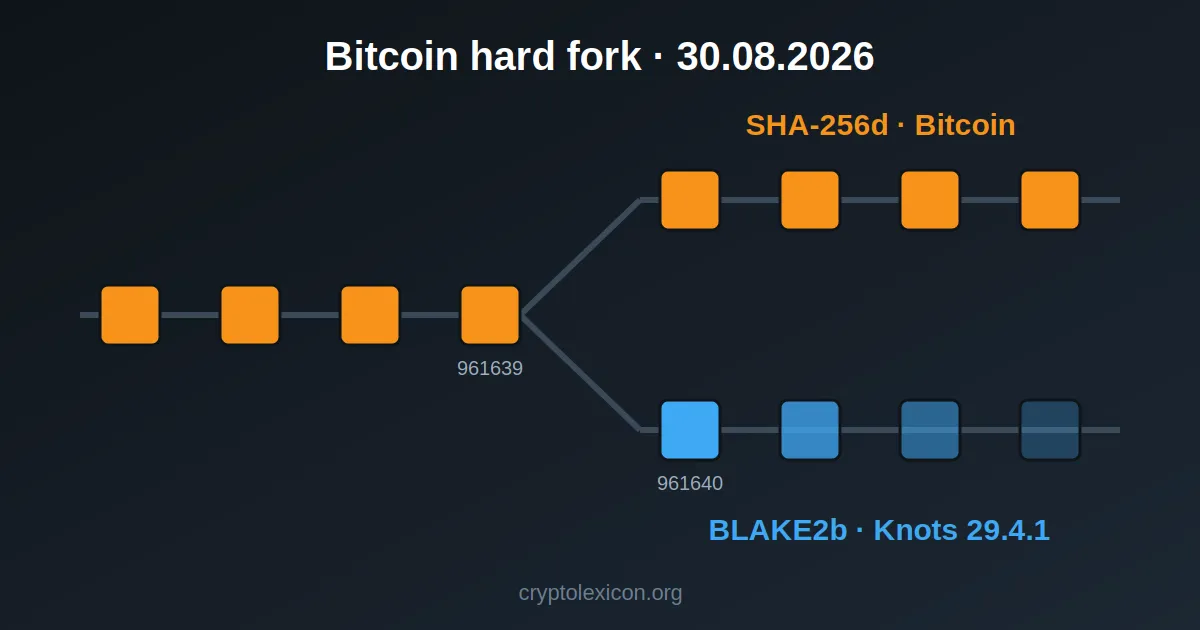
Bitcoin Knots, the alternative Bitcoin client maintained by Luke Dashjr, has split from the main network and swapped its proof-of-work algorithm from SHA-256d to BLAKE2b. The first BLAKE2b block, 961640, was mined on August 30; the final Knots 29.4.1 release shipped on September 2; and on September 4 Dashjr publicly called the coins traded on exchanges "fake bitcoins". This article covers the timeline, the technical substance of the changes, how miners and exchanges reacted, and a step-by-step guide to running a node plus DATUM Gateway if you want to mine the new chain. At the end: what BTC holders and pool operators should double-check.
📌 Status as of September 4, 2026: the main Bitcoin network (SHA-256d) is running without interruption and BTC trades near $80,000. The BLAKE2b chain is not listed on any major exchange, and its hashrate has been falling since launch.
📌 Update, October 6, 2026. Knots 29.4.2 shipped on September 21; install it rather than 29.4.1. It activates a long coinbase maturity soft fork: coins from blocks starting at 973440 can only be spent after 6480 confirmations instead of 100. AlphaPool's stratum pool is closed, and mining now goes only through your own DATUM Gateway. Details in the "What changed in Knots 29.4.2" section below.
Timeline: from BIP-110 to an algorithm swap
The fork is not a sudden event but the end of a month-long chain of failures.
| Date | Event |
|---|---|
| August 8, 2026 | Nodes enforcing BIP-110 (a ban on non-financial data in blocks) stop accepting "regular" blocks. The soft fork needed 55% miner signaling; it peaked at 2.53%. The BIP-110 chain dies after two blocks. |
| August | Mining pool OCEAN routes customer hashrate to the minority chain for about 18 hours without clear consent. The pool's hashrate drops roughly 96% over the month; miners demand leadership changes. |
| August 29 | Dashjr asks SHA-256 miners to stop ahead of a "rehearsal" for the algorithm change. Knots 29.4.1rc4 ships with activation height 961640. |
| August 30, 06:14 UTC | Block 961640 is mined, the first on BLAKE2b. Block 961639 is the last SHA-256d block. |
| September 1 | rc5 adds a checkpoint at block 961640: a rollback is no longer possible. Dashjr resigns as chairman and CTO of OCEAN, which buys back his equity. He now leads CONVOY Mining. |
| September 2, 19:02 UTC | Final release 29.4.1.knots20260508. |
| September 4 | Dashjr says exchanges that never ran their own full nodes are "selling fake bitcoins". He calls the main chain "Spamcoin". |
The irony: for years Knots positioned itself as a "stricter" client of the same network as Bitcoin Core. From block 961640 it is a different network.
What BLAKE2b is and why your ASIC is useless here
BLAKE2b is a fast hash function miners know from Siacoin and ScPrime (the "Blake2B-Sia" algorithm). It has nothing in common with SHA-256d, which every modern Bitcoin ASIC is built for: Antminer S19/S21, Whatsminer M-series and so on. Those machines physically cannot compute BLAKE2b; after block 961639 they can only mine the main SHA-256d chain.
Dashjr's reasoning for the swap:
- BLAKE2b removes ASICBoost, an optimization that gives large SHA-256 miners an efficiency edge;
- the new chain no longer depends on the industrial miners who ignored BIP-110;
- it is supposed to let "ordinary computers" mine again.
That last point collapses under the numbers. Existing BLAKE2b ASICs, such as the Antminer A3, Goldshell SC5 Pro and SC Lite, deliver hundreds of GH/s to tens of TH/s. An RTX 3090 on a Sia pool manages about 5 GH/s, two to three orders of magnitude below a single Goldshell box. A desktop CPU sits several more orders of magnitude behind the ASICs; the community site that launched as "CPUMINERS" renamed itself after running the measurements.
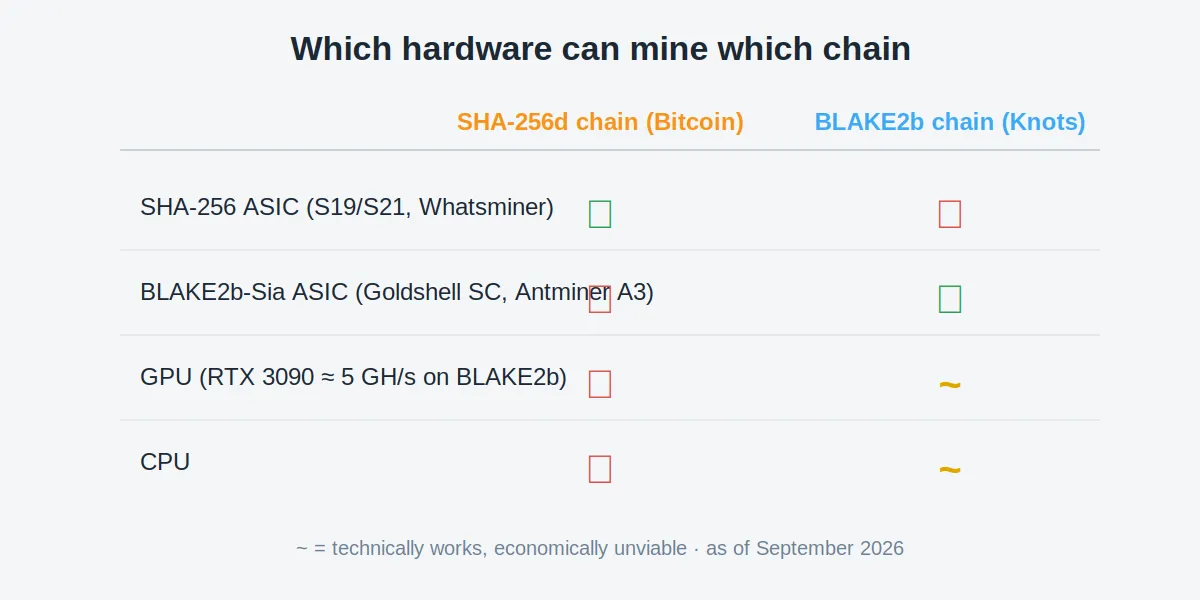
⚠️ Important. If you run SHA-256 ASICs, nothing has changed for you: keep mining the main chain. The one thing worth checking is whether your pool has quietly moved hashrate to the fork (see the pools section below).
What exactly changed in Knots 29.4.1 consensus
The release notes put the changes in a single list:
- BLAKE2b proof-of-work from height 961640 (mainnet) and 150308 (testnet4). The block header moves to a "header-v2" format.
- BIP-110 / "reduced data": a limit on non-financial data in blocks, activated at the same height.
- A temporary 800 kWU block weight limit instead of the usual 4,000 kWU.
- An opt-in unified sighash (SIGHASH_UNIFIED): a replay-protection mechanism that is not enabled by default.
- RDTS at a flag day (an extra consensus rule, enabled via
consensusrules=rdts). - Checkpoints at blocks 961632, 961639 and 961640: the node rejects any SHA-256d chain above 961639.
The key point for holders: private keys and addresses do not change. Every UTXO that existed before block 961640 is spendable on both chains. That is exactly why item 4 matters: without the opt-in sighash, a transaction broadcast on one chain can be replayed on the other.
What changed in Knots 29.4.2
The release shipped on September 21. The developers ask users to upgrade as soon as possible and to plan ahead for the next updates: around mid-October and in August 2027.
- Long coinbase maturity (knots#419, "part 1 of 3"). For blocks 973440 (around September 22) through 979920, coinbase coins can only be spent after 6480 confirmations instead of 100. The developers describe it as locking new rewards for roughly 45 days.
- What the PR plans next. Step two extends maturity to a full year, until RDTS expires. Step three, near the end of that year, withholds rewards for blocks produced by "non-miners", meaning blocks mined via Stratum-to-pool without your own block template.
- The developers' position. The release notes say it plainly: if you mine without running your own DATUM Gateway, in their view you are not mining but attacking the network, and you may never be paid rewards going forward.
- RPC. SHA-256d and BLAKE2b difficulty use different units, so
getdifficultywas removed, and BLAKE2b blocks andgetblockchaininfonow report adifficulty_blake2bfield (knots#420). - Pruned nodes. If your node is already pruned past September 21 when you upgrade, it may need a full resync. Knots asks at startup if so.
⚠️ Important. Nodes on 29.4.1 do not check the new rule, and AlphaPool explicitly says older versions are on the wrong rules. If you follow the BLAKE2b chain, upgrade to 29.4.2.
Market reaction: the numbers on September 4
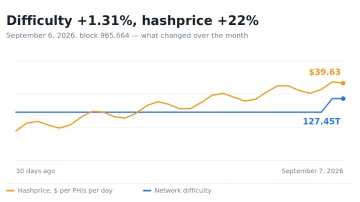
- Hashrate on the BLAKE2b chain has declined since launch, while one of the proposed starting difficulties would have required about 870 TH/s and the entire testnet4 was estimated at 50–70 TH/s.
- No major exchange has listed the fork coin. A single small venue opened deposits under the unofficial ticker BTCB2: bids around $82, asks around $190, a spread of roughly 131%. For comparison, BTC on the main chain trades near $80,670 (September 4 data).
- No widely used wallet, custodian, block explorer or Lightning implementation committed to supporting the chain before launch.
- Adam Back (Blockstream) summed it up in one line: "Live by the fork, die by the fork."
In market terms the fork repeated the fate of August's BIP-110 chain, only more slowly.
What it means for miners and pools
SHA-256 ASIC owners. Do nothing except check your pool. The OCEAN episode showed a pool can move hashrate to a minority chain without telling you. Warning signs: a spike in rejected shares, an "odd" block height in pool stats, missing payouts. Compare the height and hash of the pool's latest block against any public explorer of the main network. Our guide on how to choose a mining pool covers what to look at, and we explained the causes of rejected shares separately.
BLAKE2b (Sia) ASIC owners. Technically your Goldshell or A3 can mine the new chain from block one; CONVOY supports a "BLAKE2b-sia" mode. Economically it is a bet on a coin with no market: the only price reference is $82 on a venue with zero liquidity. Siacoin and ScPrime still trade.
GPU and CPU. Unprofitable at any price, see the numbers above.
💡 If you own a Sia ASIC and want to try it "for science", the working stack is below. Just don't shut down your main mining for it.
How to run a node and mine the BLAKE2b chain
The official path is Bitcoin Knots 29.4.2 plus the DATUM Gateway from CONVOY. The chain has no conventional pools right now, where you plug in a stratum URL and go: both CONVOY and AlphaPool accept hashrate only through your own DATUM Gateway, and solo mining uses the same stack.
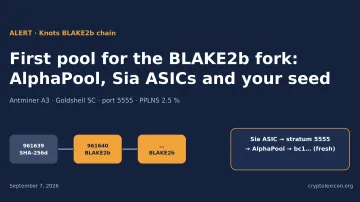
📌 Update, October 6: AlphaPool's stratum pool, which launched on September 7, is closed. AlphaPool now runs as a DATUM pool: the same stack as below, with the pool set in the Gateway instead of solo. Details in the first-pool alert.
Step 1. Install Knots 29.4.2
Download 29.4.2.knots20260508 for your architecture from Bitcoin Knots and verify SHA256SUMS against the signature. If you already run a Core mainnet node, keep the same data directory: Knots walks back to block 961639 and downloads the BLAKE2b chain. A pruned node that has advanced far along the SHA-256d chain will need a full resync. If you are upgrading from 29.4.1 and your node is pruned past September 21, Knots will offer a resync at startup.
Minimal bitcoin.conf:
server=1
rpcbind=127.0.0.1
rpcallowip=127.0.0.1
rpcuser=USER
rpcpassword=PASS
blocknotify=curl -fsS -o /dev/null http://127.0.0.1:7152/NOTIFY
Do not set chain=testnet4. The P2P port is 8333, forward it on your router; keep RPC (8332) on localhost.
Step 2. Confirm the node is on the right chain
bitcoin-cli getblockchaininfo
bitcoin-cli getdeploymentinfo
getdeploymentinfo should report blake2b.height = 961640 and blake2b.active = true, plus reduced_data at the same height.
Step 3. Build the CONVOY DATUM Gateway
Clone the CONVOYMining/datum_gateway repository and build it per the README (cmake, libmicrohttpd, jansson, curl, libsodium). You need commit 56c31f4 or later: older builds hashed the header without the header-v2 bit, so almost every block at real difficulty was rejected as high-hash.
Example datum_gateway_config.json for solo:
{
  "bitcoind": { "rpcuser": "USER", "rpcpassword": "PASS", "rpcurl": "http://127.0.0.1:8332" },
  "stratum": { "listen_addr": "0.0.0.0", "listen_port": 23334 },
  "api": { "listen_addr": "0.0.0.0", "listen_port": 7152, "admin_password": "CHANGE_ME", "modify_conf": true },
  "mining": { "pool_address": "YOUR_ADDRESS_bc1q", "coinbase_tag_primary": "RIG_ID", "allow_hasher_time_rolling": false },
  "datum": { "pool_host": "", "pooled_mining_only": false }
}
A common mistake: leaving pooled_mining_only: true with an empty pool_host, which makes the process exit. CONVOY's default config is a pool example, not a solo recipe.
Step 4. Connect the miner
Point a BLAKE2b or BLAKE2b-sia device at stratum+tcp://HOST:23334; the worker name can be anything DATUM accepts, often a payout address. The DATUM web UI is at http://HOST:7152.
Check that the block template advertises the right algorithm:
bitcoin-cli getblocktemplate "{\"rules\":[\"segwit\",\"blake2b\"]}"
The response should include !blake2b in the rules list. A healthy setup accepts shares, logs BLOCK FOUND - <hash> on a find, and that hash equals the new tip; a second duplicate line is normal (DATUM submits twice).
Safety: replay, "fake bitcoins" and your coins
🔒 Do not move BTC "because of the fork". Coins that existed before block 961640 already exist on both chains. No action is needed to "receive" fork coins.
Replay protection on the fork is opt-in. If you ever decide to sell BTCB2, the fork's site recommends first sending the coins to yourself on the BLAKE2b chain with a SIGHASH_UNIFIED transaction and only then touching the main balance. No mainstream wallet supports that sighash yet; verify before any operation.
The "fake bitcoins" statement is one developer's position, not a fact: chain data, price and hashrate remain with the SHA-256d network. Treat any link to an "official fork wallet" or an "exchange listing BTCB2" as potential phishing. We described how users behave during a run of forks on another coin in our Pearl forks timeline.
Frequently asked questions (FAQ)
Can my Antminer S21 mine the BLAKE2b chain? No. SHA-256d chips cannot compute BLAKE2b. You need a Sia-class ASIC (Goldshell SC, Antminer A3) or a compatible miner with header-v2 support.
Will my bitcoins disappear because of the fork? No. Keys and addresses did not change, and UTXOs from before block 961640 exist on both chains. The main network runs normally.
What if my pool switched to the fork? Switch pools. Compare the height and hash of the pool's latest block with a public explorer of the main network; if they differ, leave.
What is BTCB2 worth? On the one small venue, bids sit around $82 against asks near $190 (as of September 4, 2026). That is not a market price; it is the absence of a market. According to Cryptopolitan, after a $1,799 peak on September 5 the price had dropped to $270–315 by September 21, still on thin venues.
Should I install Knots 29.4.2 "just as a node"? Only if you deliberately want to follow the BLAKE2b chain, and then it has to be 29.4.2: 29.4.1 does not check the coinbase maturity rule. For the main Bitcoin network both versions are unusable: they reject every SHA-256d block above 961639.
Why can't I spend the reward for a block I found right away? Since block 973440 the soft fork from Knots 29.4.2 applies: coinbase coins become spendable only after 6480 confirmations instead of 100. The rule is the same for solo miners and pools.
Could the fork "come alive" later? In theory, if meaningful BLAKE2b hashrate arrives and listings follow. As of September 4 the trend is the opposite: hashrate is falling and there is no infrastructure support.
Sources
- Bitcoin Knots — release 29.4.2: September 21 date, long coinbase maturity,
difficulty_blake2b, resync for pruned nodes, planned updates. - Bitcoin Knots — PR #419: heights 973440 and 979920, the three steps of the change.
- AlphaPool — DATUM pool: closure of the stratum pool and DATUM pool terms.
- CONVOY — DATUM Gateway setup: connecting the Gateway to the CONVOY pool.
- Cryptopolitan — report on the reward lock: BTCB2 price on September 21.
This material is for informational purposes only and is not financial advice. Hashrate, price and software version figures are as of September 4, 2026, updated October 6, 2026, and may change.