Knots BLAKE2b chain: what happened to the first pool, and why you never import a seed for BTCB2
The first Knots BLAKE2b pool: AlphaPool shut its SV1 pool, mining now needs your own node and DATUM, rewards wait 6,480 blocks. Why you never import a BTC seed.
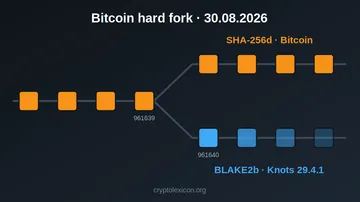
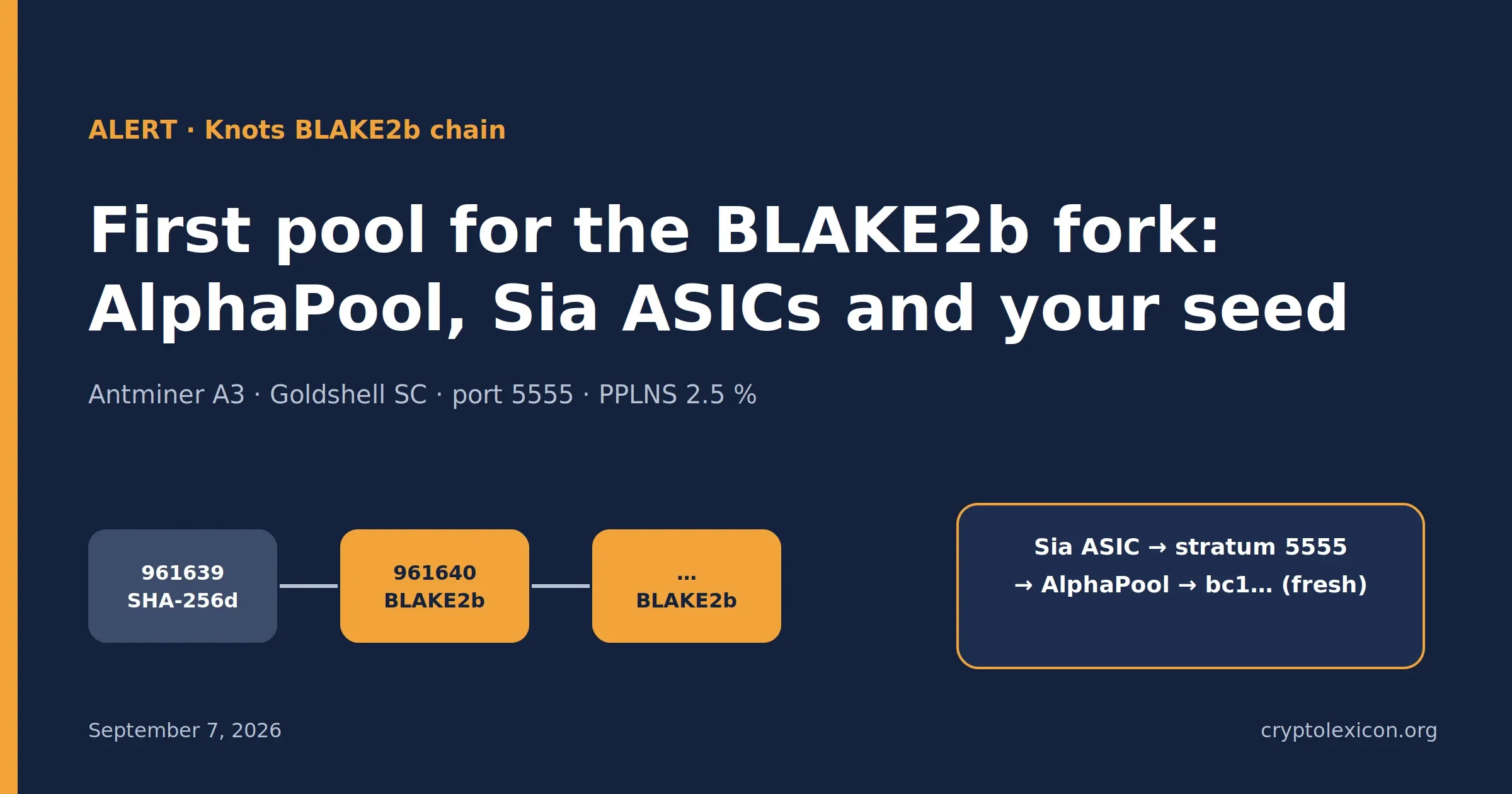
In our September 4 breakdown of the BLAKE2b fork we wrote that the chain had no regular pools — only solo via Knots + DATUM. That is out of date: AlphaPool has stood up a stratum pool a Sia ASIC joins like any Siacoin pool, with no reflash. Meanwhile a retelling of the fork with a dangerous piece of advice about importing seed phrases is doing the rounds on channels. Below: what changed, how to connect and what not to do.
📌 Update, October 6, 2026. Parts of this article are out of date. What changed:
- AlphaPool's stratum pool is closed. The addresses on ports 5555 and 7777 no longer accept hashrate. The pool moved to DATUM, so you now need your own Knots node and your own DATUM Gateway. AlphaPool says rewards earned on the old pool will be paid once the coins become spendable.
- Block rewards are locked. Knots 29.4.2, released September 21, activated a long coinbase maturity rule: coins from blocks starting at 973,440 can only be spent after 6,480 confirmations instead of 100. The developers describe it as a lock of roughly 45 days.
- Run 29.4.2 only. According to AlphaPool, nodes on older versions are on the wrong rules.
- Price. According to Cryptopolitan, by September 21 BTCB2 had lost about 84% from its $1,799 peak and traded in a $270–315 range.
How to connect now is covered in the section of the same name below.
📌 Status as of September 7, 2026: the main Bitcoin network is running normally, BTC around $79,700. The Knots BLAKE2b chain has been live since block 961,640, with blocks arriving roughly every 2.8 minutes by the pool's own count. There is still no listing on a major exchange, and neither CoinMarketCap nor CoinGecko tracks the coin. There are now two venues: Neoxa Exchange (BTC, USDC and USDT pairs) and Nonkyc.io (USDT). The price ran over the weekend: an all-time high of $1,799 on September 5, then $750–1,000 on the morning of September 6, on roughly $1M of daily volume.
What was new as of September 7
1. The first pool. AlphaPool runs PPLNS with a 2.5 % fee, on-chain payouts after 100 confirmations, funded only from the coinbases of found blocks. Four relays — us1, us2, eu1, sg1 — on one pool, shared balance.
2. Stock firmware. The fork's v2 header is 164 bytes, but the pool collapses it into a standard 80-byte Sia work header. The ASIC hashes it like ordinary Siacoin work: Goldshell SC/HS and Antminer A3 connect with no custom firmware. iBeLink BM-S3+ and other Sia-firmware devices use a separate port, 7777.
3. Two venues now, and the price broke loose. The venue we described as "the single small one" is Neoxa Exchange, and it now runs three pairs: BTCB2/BTC, BTCB2/USDC and BTCB2/USDT. A second listing appeared on Nonkyc.io with a USDT pair. Over the weekend the price ran from tens of dollars to an all-time high of $1,799 on September 5, then settled back into a $750–1,000 range. Volume is around $1M per day on the USDC pair.
The conclusion from the earlier version does not change, but it needs sharpening: there is still no real market — not for lack of trades now, but because of their size. At $1,000 per coin, BTCB2's fully diluted valuation sits near $20.9 billion, which would put it ninth among all coins if the valuation were real. Holding it up is $1M of daily turnover across two obscure venues. That is price discovery, not a market, and any price here lasts exactly until the first large order.
How to connect now
The stratum address from the first version of this article (eu1.alphapool.tech, ports 5555 and 7777) no longer works. AlphaPool closed its Stratum V1 pool and now accepts hashrate only through DATUM, the same way CONVOY does.
The setup is now the same as for solo mining in the main fork breakdown, with one difference in the settings:
- Run your own Bitcoin Knots 29.4.2 node.
- Build a DATUM Gateway and connect it to the node.
- In the Gateway settings, point it at a DATUM pool instead of solo. AlphaPool lists its parameters on the Get Started page at
xbt.alphapool.tech; CONVOY's pool settings are already the Gateway's built-in defaults. - Point the ASIC at your own Gateway, not at a pool address.
AlphaPool's DATUM pool terms as of October 6:
| Parameter | Value |
|---|---|
| Payout scheme | TIDES: the reward is split by your share of the work in a window worth 8 blocks (8 × difficulty) |
| Pool fee | 2.5% |
| Block finder bonus | 0.5% of the block goes to the miner who found it |
| How payouts arrive | straight into the found block's coinbase at your bc1… address: no pool balance, no withdrawals, no minimum payout |
| When the coins become spendable | 6,480 confirmations after the block |
⚠️ Important. In the 29.4.2 release notes, the Knots developers call mining without your own DATUM Gateway an attack on the network and warn that such miners may never be paid in the future. PR #419 sets this out as step three: first 45 days of maturity, then a full year, and near the end of that year withholding rewards for blocks produced via Stratum-to-pool. The next Knots updates are announced for mid-October and August 2027.
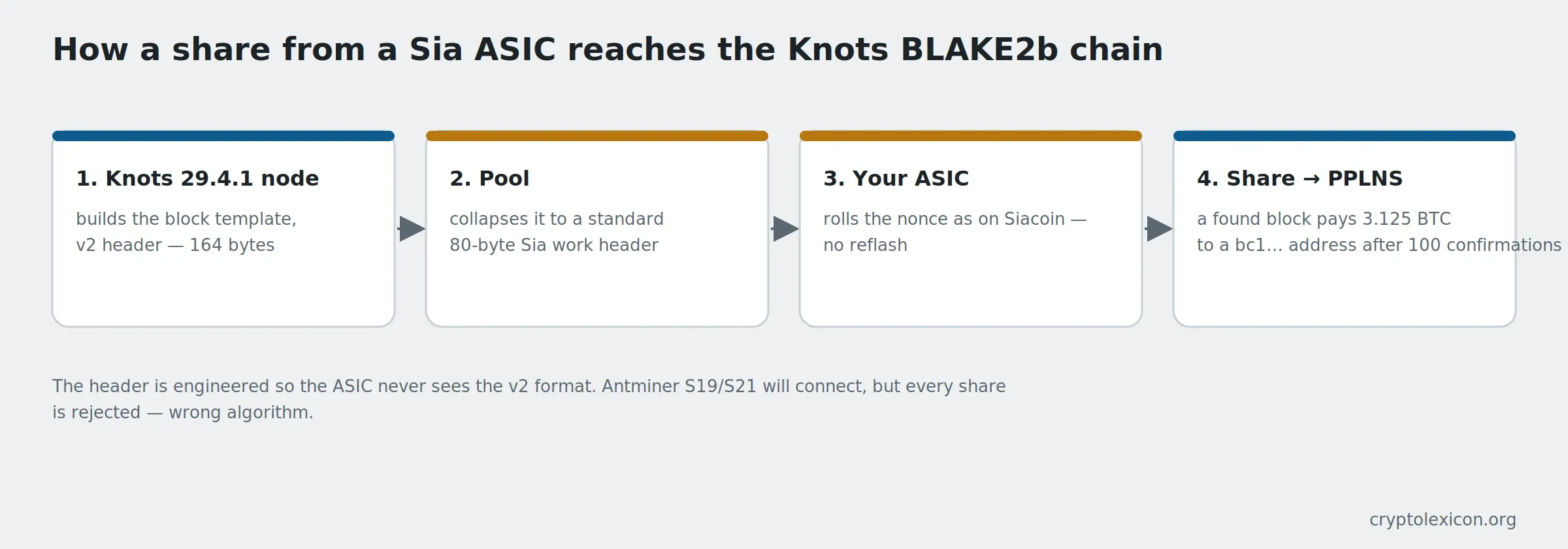
Hashrates AlphaPool quotes at stock: Goldshell SC5 Pro — 11 TH/s at 2,820 W, Goldshell HS5 in Sia mode — 5.4 TH/s at 1,500 W, iBeLink BM-S3+ — 25 TH/s, Antminer A3 — "legacy, still valid". Antminer S19/S21 and Whatsminer will connect, but every share goes to reject — wrong algorithm. What a spike in rejected shares means and how to tell it from pool problems is in rejected shares.
⚠️ Important. The economics did change, though not in the way you might want to read it. BTCB2's price multiplied over the weekend and gave most of it back just as fast: a high of $1,799, then $750–1,000, all on venues with no order-book depth. The pool still states that the coins may be worth nothing. You can sell at the price on the chart only for as much volume as the book will absorb — and it is thin. If you own a Sia ASIC, this remains an experiment paid for in electricity, with an unpredictable outcome. Siacoin and ScPrime trade on normal exchanges.
About the seed phrase: what not to do
A retelling of the fork is circulating on Telegram with the line "importing your private keys / seed phrase is required to receive BTCB2." The wording is inaccurate, and that inaccuracy is exactly how people lose real BTC.
Fork coins do not need to be received — you already have them. Both chains share the same keys and addresses, and every UTXO that existed before block 961,640 exists on both. There is nothing to claim, register or send anywhere; the fork's own site confirms this in its "You need to know" section.
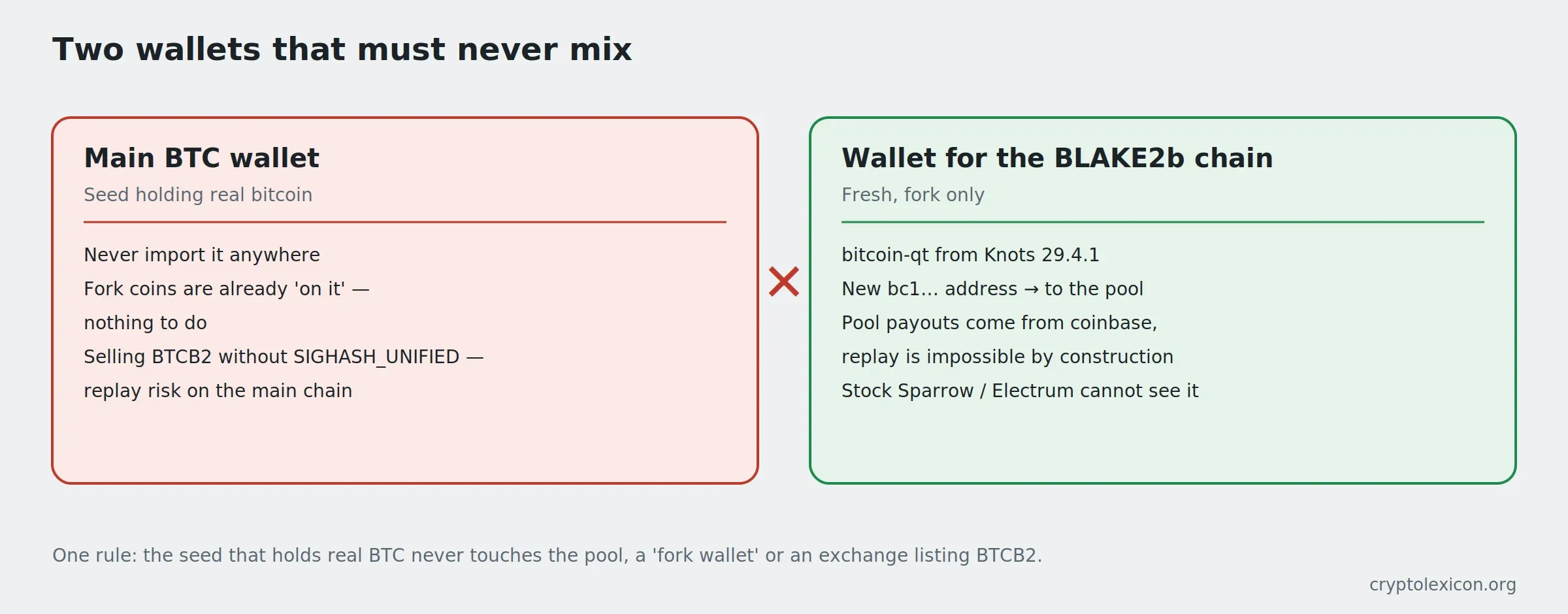
Keys are not needed to receive the coins. They are needed to spend them, same as on any chain. The gap between those two words is the entire scam: "import your seed to receive free coins" is the 2017 fork wave, word for word. A "fork wallet" like that reads nothing — it ships your seed to someone else's server, and a minute later the coins leave the main chain.
If you are only mining
You do not need your old keys at all. Pool payouts come from the coinbase of post-fork blocks and by construction cannot exist on the main chain — your mainnet coins stay isolated. AlphaPool makes this rule number one in its own FAQ: a fresh wallet for this chain only, never a seed that holds real bitcoin.
- Install Knots 29.4.2 from the GitHub release
bitcoinknots/bitcoin(tagv29.4.2.knots20260508) and create a new wallet in itsbitcoin-qt. Replay-protected signing is on by default there. - Copy the bc1… address from that wallet: that is where payouts go, and it is the address you enter in your mining setup.
- That is all. Your old seed never enters the process.
Stock Sparrow and Electrum do not see this chain and will show a zero balance. Patched builds (Shrike, Sparrow BLAKE2b) exist, but they are new and unaudited.
If you held BTC before block 961,640
Then you do have a balance on the BTCB2 side, and moving it does require the keys to those addresses. A fresh empty wallet will not see your fork coins. There is exactly one safe sequence here, and the order is the only thing protecting you:
- Move all real BTC off the old seed to a new wallet with a new seed. Wait for confirmations and verify the old addresses are empty.
- The old seed now holds nothing of value on the main chain — there is nothing left to steal from it.
- Only at this point, import the old seed into a fork wallet.
- Before your first send, split the pre-fork coins with a
SIGHASH_UNIFIEDtransaction, or the payment may be replayed on the main chain. Details in the replay section of the main article.
The reverse order — importing a seed that still holds live BTC, "just to check the balance" — is precisely how money was lost in 2017.
🔒 While a seed still holds real BTC, it goes nowhere near a pool, a "fork wallet" or an exchange. Links to an "official fork wallet" or a "BTCB2 listing" from Telegram channels are phishing by default.
What it changes for everyone else
For SHA-256 ASIC owners — nothing beyond the same check as before: make sure your pool has not moved hashrate to the minority chain the way OCEAN did in August. How to choose a pool and what to look at is in how to choose a mining pool.
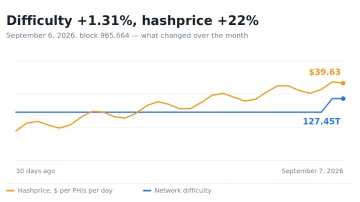
For the chain itself this is the first sign of infrastructure forming around it, and the picture shifted noticeably over the week. BTCB2 hashrate is up roughly 30% in seven days and sits near 5.1 PH/s, with around sixty distinct pools and solo miners on the chain — Pyblock is the largest, followed by Mycology, Pow.re, Placeholder, Knots and AlphaPool. Listings went from one to two.
None of this overturns the diagnosis from the main article. There is still one official wallet and two unaudited ones, both exchanges are obscure, and rising hashrate on a young chain mainly means mining it became speculatively profitable — which unwinds as fast as it built up.
Sources
- Bitcoin Knots — release 29.4.2: September 21 date, long coinbase maturity, the developers' position on mining without your own DATUM Gateway, plans for October and August 2027.
- Bitcoin Knots — PR #419: blocks 973,440 and 979,920, the three steps of the change.
- AlphaPool — closed stratum pool page and DATUM pool: the closure, payout of old rewards, TIDES, fees, 6,480 confirmations.
- Cryptopolitan — report on the reward lock: BTCB2 price after the peak.
This material is for informational purposes only and is not financial advice. Pool, exchange and software version data are as of September 7, 2026, updated October 6, 2026, and may change.