How to choose an ASIC miner for your electricity price
J/TH efficiency and your kWh rate decide if an ASIC earns or runs at a loss. Break-even rate formula, three price classes and a payback table with real numbers.
The real question when buying an ASIC is not "which model is most powerful" but "which one pays off at my electricity rate". The same machine turns a profit at $0.05/kWh and runs at a loss at $0.12. This guide shows how efficiency (J/TH) and your rate together decide the outcome, gives you a simple break-even formula, breaks the market into three price classes, and puts real September-2026 numbers into a payback table. By the end you will be able to work out for yourself which miner makes sense for you specifically.
📌 Live data. Checked as of September 2026:
- Hashprice: ~$32 per PH/s per day
- BTC price: ~$64,000
- Network difficulty: ~125.8 T
Every calculation in this article uses this hashprice. These values change daily — verify them on Hashrate Index, and recompute on a calculator before buying. At these values older machines at 30+ J/TH already run at a loss on residential power.
The two numbers that decide everything
Every ASIC has a spec sheet, but only two figures matter for the buying decision.
Hashrate (TH/s) — how many terahashes per second the machine produces. It sets how much coin you mine.
Efficiency (J/TH) — how many joules of energy go into one terahash. It is watts divided by hashrate. The lower the J/TH, the less you pay in electricity for the same output.
Efficiency matters more than hashrate. Two machines can draw the same watts from the wall, but the one with twice the efficiency produces twice the hashrate — that is, twice the coin for the same electricity spend.
💡 Rule of thumb: hashrate is how much you mine, efficiency is how much you pay for it. Profit lives in the gap between them.
The third number is your kWh rate. That is what turns efficiency into money. The same ASIC is profitable on a cheap industrial rate and loss-making on a residential one. That is why "the best ASIC overall" does not exist: there is a best ASIC for your rate.
What hashprice is and why it rules here
Hashprice is the expected revenue per unit of hashrate per day, usually in dollars per PH/s per day (1 PH/s = 1000 TH/s). It is what the network pays a miner for their work.
Hashprice depends on the BTC price, network difficulty, block reward and transaction fees. You do not need to compute it yourself — the current value is published by Hashrate Index and others. In September 2026 it sits around $32 per PH/s per day, one of the lowest levels in the network's history.
The revenue formula is simple:
Daily revenue ($) = machine hashrate (PH/s) × hashprice ($/PH/s per day)
Example: a 200 TH/s machine = 0.2 PH/s. At a $32 hashprice, revenue = 0.2 × 32 = $6.4/day before electricity.
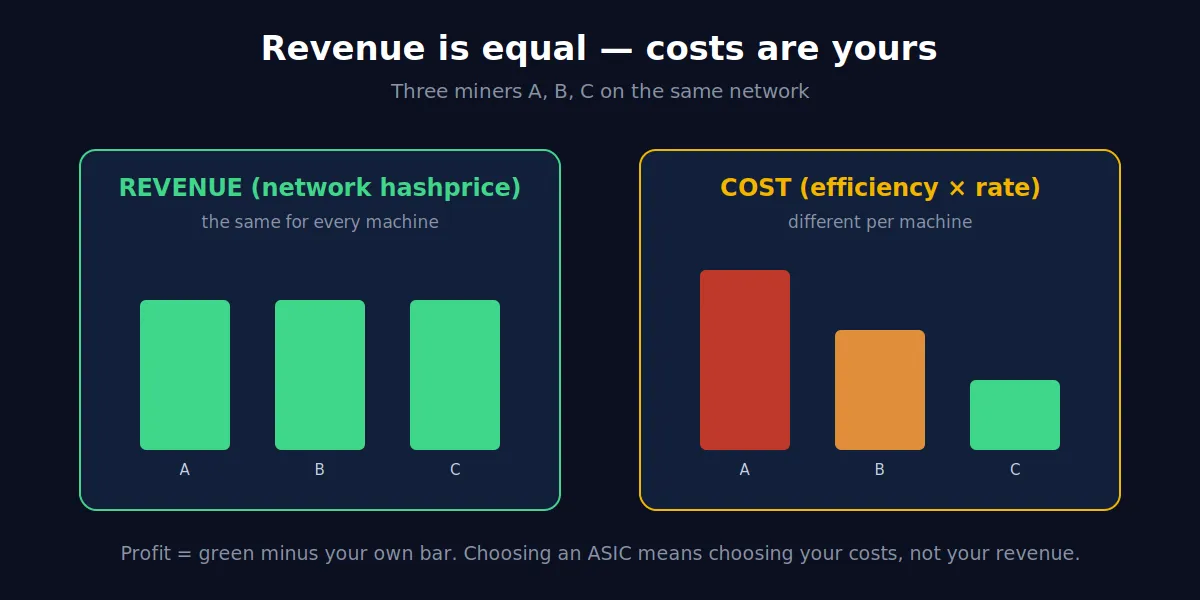
⚠️ Important. Hashprice is network-wide; it does not depend on your machine model. The model only affects costs — how much electricity you burn to earn that revenue. So choosing an ASIC = choosing your costs, not your revenue.
The formula: work out your break-even rate
One calculation instantly filters out the wrong machines — the break-even rate, the electricity price at which the machine earns exactly zero. If your rate is higher, the machine runs at a loss.
Step 1. Daily electricity cost:
Daily cost ($) = power (kW) × 24 × rate ($/kWh)
Step 2. Set revenue equal to cost and solve for the break-even rate:
Break-even rate ($/kWh) = daily revenue ($) ÷ (power (kW) × 24)
Worked on a real machine. Antminer S21 (200 TH/s, 3500 W = 3.5 kW), hashprice $32 from the block above:
- revenue: 0.2 PH/s × $32 = $6.4/day;
- break-even rate: 6.4 ÷ (3.5 × 24) = 6.4 ÷ 84 = $0.076/kWh.
Conclusion: the S21 breaks even around 7.6 cents. At $0.05 it profits, at $0.10 it loses. All you have to do is compare your rate with this number.
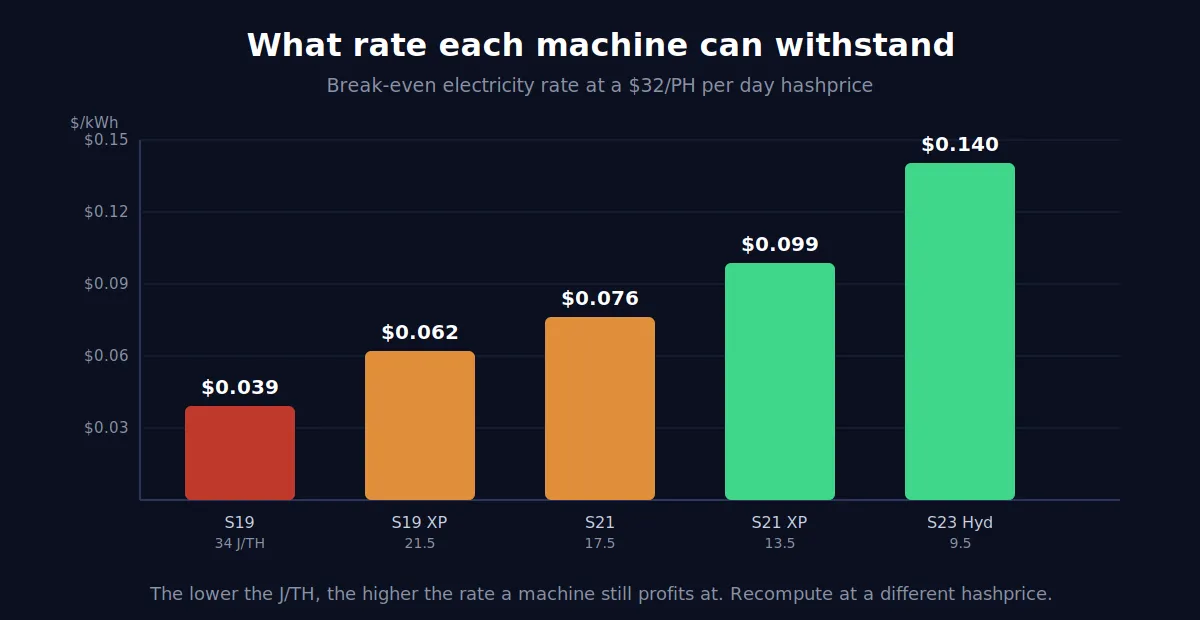
💡 Keep the formula handy while browsing listings. Once you know a machine's watts and hashrate, you can estimate its break-even rate in a minute and immediately tell whether it is a machine for you.
The three ASIC price classes in 2026
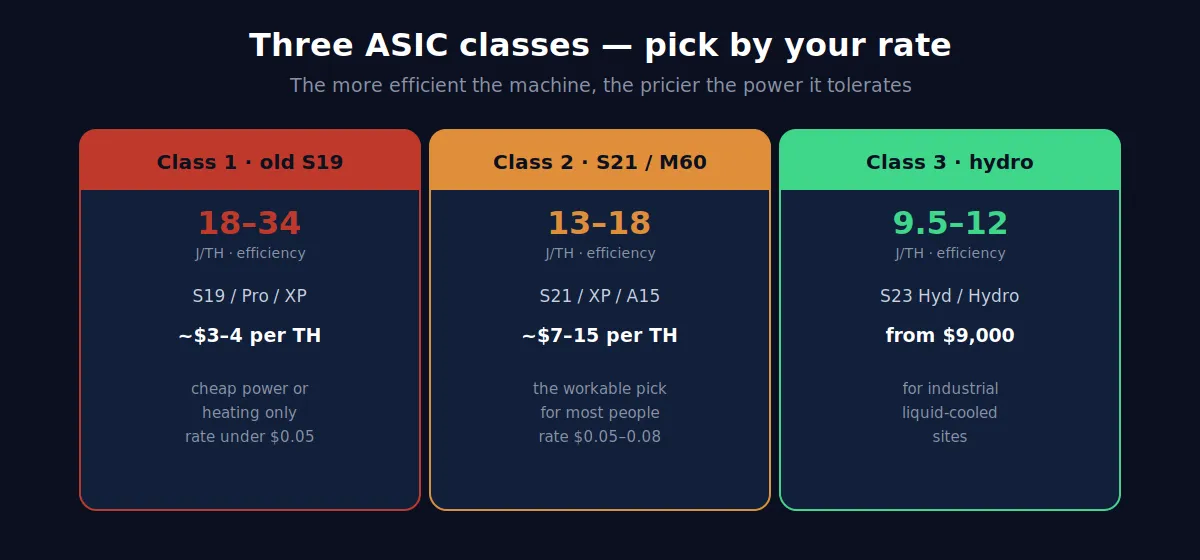
The market splits into three clear tiers. Your rate decides the class.
Class 1. Old S19s (18–34 J/TH) — cheap power only
The former flagships of 2020–2022: Antminer S19, S19 Pro, S19j Pro, S19 XP. On the secondary market they are the cheapest, roughly $3–4/TH, and plain S19s go for less. But efficiency is poor: from 21.5 J/TH on the S19 XP to 30+ J/TH on early versions.
The problem is that at a $32 hashprice these machines already lose money on residential power. An Antminer S19 at 95 TH/s (34 J/TH) at $0.07/kWh returns about −$1.7/day — you are paying to mine. They only profit at rates below roughly $0.05–0.06.
Who it fits: people with nearly free electricity, or those using the machine's heat for home heating (which effectively zeroes out the electricity cost — you would be paying to heat anyway).
Class 2. Current air-cooled S21 / M60 / A15 (13–18 J/TH) — the workable pick for most
The current air-cooled generation: Antminer S21, S21 Pro, S21 XP, WhatsMiner M60 series, Avalon A15 series. New prices are roughly $7–15/TH, used is cheaper. Efficiency ranges from 13.5 J/TH on the S21 XP to about 17.5 J/TH on the base S21.
This is the price/efficiency sweet spot for a home farm or small hosting. These machines stay profitable at higher rates than Class 1, and the electricity difference quickly repays the higher purchase price.
Who it fits: most people — a rate around $0.05–0.08, placement in a garage, basement or hosting.
Class 3. Hydro and immersion (9.5–12 J/TH) — for industrial sites
The efficiency top tier: Antminer S23 Hyd (~9.5 J/TH), S21 XP Hydro, immersion models. Prices start at $9,000–10,000 per machine. But they need liquid-cooling infrastructure that a home usually does not have.
Who it fits: industrial miners and sites with a hydro or immersion loop. For home use it is overkill unless you are building immersion on purpose.
Table: payback by class
Approximate September-2026 numbers, hashprice ~$32, for orientation. Verify on a current calculator.
| Class | Example model | Efficiency | Break-even rate | At $0.05/kWh | At $0.10/kWh |
|---|---|---|---|---|---|
| Old S19 | S19 95 TH | ~34 J/TH | ~$0.046 | around zero | deep loss |
| Old S19 | S19 XP 141 TH | ~21.5 J/TH | ~$0.073 | profit | loss |
| Current | S21 200 TH | ~17.5 J/TH | ~$0.076 | profit | loss |
| Current | S21 XP 270 TH | ~13.5 J/TH | ~$0.099 | solid profit | around zero |
| Hydro | S23 Hyd | ~9.5 J/TH | noticeably higher | solid profit | still profit |
The pattern is clear: the lower the J/TH, the higher the rate the machine can withstand. The break-even rate is your main compass when choosing.
⚠️ Important. The table numbers are for a specific date at a specific hashprice. If hashprice rises, break-even rates go up and loss-making machines turn profitable again; if it falls, the reverse. The September 6, 2026 retarget shows how fast this happens: difficulty rose 1.31% while hashprice jumped 22%, and the break-even rates in the table rose with it. Never decide on last year's numbers.
What else to weigh besides J/TH
Efficiency and rate are the main thing, but not the only thing.
Purchase price vs electricity savings. A cheap used S19 often costs more over its life: the electricity difference eats the price savings within months. Compute total cost of ownership, not just the sticker price.
Power supply. Powerful ASICs need 220–240 V and a dedicated circuit with a 16–20 A breaker. You cannot plug one into a household outlet — you need an electrician and possibly a separate cable. These are one-off costs, but budget for them.
Noise and heat. Air-cooled ASICs put out about 70–75 dB — like a running vacuum cleaner, around the clock. Not for living rooms: you need a garage, basement or sound box. The heat has to go somewhere too.
Repairability and parts. Bitmain has the widest service and parts network; MicroBT and Canaan are narrower. When a hashboard fails at month seven, parts availability sets your downtime.
Used condition. Secondary-market machines often carry thousands of operating hours. Before buying, check the hashboards, chips and logs — a separate guide on buying used ASICs will cover how. The log-reading instructions are already live: Antminer kernel log: what the errors mean — the lines in the log show whether a board is alive before you even start mining.
The wider industry backdrop is worth keeping in mind too: in 2026 many operators are converting sites from ASICs to AI compute, and some old hardware is landing on the secondary market — why that is happening is covered in Hyperscale Data switches off ASICs and pivots to AI.
How to choose in five steps
- Find your rate per kWh — the exact figure from your bill, with all surcharges.
- Check the current hashprice on Hashrate Index or a calculator.
- Pick the class by your rate: below $0.05 you can look at Class 1, $0.05–0.08 is Class 2, liquid cooling available is Class 3.
- Compute the break-even rate of the models you like with the formula above and drop those whose break-even is below your rate.
- Compare total cost of ownership of what remains: price + a year of electricity + power/hosting.
For a home setup at $0.05–0.08 the answer is usually a current air-cooled Class 2 machine (the S21 family or an equivalent), not the cheapest used S19.
Frequently asked questions (FAQ)
Which matters more — hashrate or efficiency?
Efficiency. Hashrate sets how much you mine, but revenue is paid at the network-wide hashprice. Efficiency sets your electricity cost, and that is what decides whether the machine profits at your rate.
Can I mine on an ASIC at a residential rate?
It depends on the machine and hashprice. At $0.10/kWh and a $32 hashprice, only the most efficient machines (around 13 J/TH and better) profit, and only with a thin margin. Old S19s at residential rates are almost always loss-making.
Why is the same ASIC profitable for some people and not others?
Because of the electricity rate. Revenue is the same for everyone (hashprice is network-wide); costs depend on the price per kWh. Cheaper electricity means the same machine profits; more expensive means it loses.
Should I grab a cheap used S19 to save money?
Only with very cheap power or for heating. Otherwise the electricity difference eats the price savings in a few months, and a pricier but efficient machine wins over its lifetime.
How do I account for the connection cost (220 V, electrician)?
Treat it as a one-off capital cost and add it to the purchase price when computing total cost of ownership. For a single machine the electrical work can cost a noticeable amount, and it changes the payback picture.
Hashprice keeps falling — is there any point entering at all?
There is, with cheap power and an efficient machine: at a low hashprice weaker players power down, difficulty eases, and the share of those who stay grows. But entering on expensive electricity at a low hashprice is a straight loss.
This material is for informational purposes only and is not financial advice. All calculations are as of the publication date at the stated hashprice and change daily; check current values before buying.